
100% Free Oracle Database 19c 1Z0-083 Dumps PDF Demo Cert Guide Cover
PDF Exam Material 2026 Realistic 1Z0-083 Dumps Questions
NEW QUESTION # 100
Which three statements are true about the keystore storage framework for transparent data encryption?
- A. It facilitates and helps to enforce keystore backup requirements.
- B. It handles encrypted data without modifying applications.
- C. It enables a keystore to be stored only in a file on a file system.
- D. It helps to track encryption keys and implement requirements such as keystore password rotation and master encryption key reset or re-key operations.
- E. It enables separation of duties between the database administrator and the security administrator.
- F. It transparently decrypts data for the database users and applications that access this data.
Answer: A,D,E
NEW QUESTION # 101
Which two are true about duplicating pluggable databases (PDBs) with RMAN?
- A. Two or more PDBs can be duplicated with the same rmak duplicate command.
- B. A user with sysdba or sysbkup must be logged in with RMAN to the PDB to duplicate it.
- C. All tablespaces belonging to a PDB must be duplicated when duplicating the PDB.
- D. The auxiliary Instance is automatically created with enable_pluggable_database = true.
- E. cdb$root and pdbSseed are automatically duplicated.
Answer: A,C
NEW QUESTION # 102
Examine this configuration: 1. CDB1 is a container database. 2. COMMON_USER_PREFIX is C##. 3. PDB1 is a pluggable database contained in CDB1. 4. APP1_ROOTis an application container contained in CDB1. 5. APP1_PDB1 is an application PDB contained in APP1_ROOT. You execute these commands successfully: Which two are true? (Choose two.)
- A. APP1_USER1 can have different privileges in each Application PDB contained in APP1_ROOT.
- B. C##_USER1will have the same privileges and roles granted in all PDBs in CDB1.
- C. P1_USER1can be created in CDB1.
- D. C##_APP_USER1 can be created in CDB1.
- E. APP1_USER1can be created in PDB1.
- F. APP1_USER1can be created in CDB1.
Answer: A,D
NEW QUESTION # 103
Which three are true about Data Pump in an Oracle multitenant environment?
- A. It can be used to clone a CDB.
- B. It can be used to transport data from a non-CDB to a PDB.
- C. It can be used to transport data between PDBs.
- D. It can be used to transport data from a PDB to a non-CDB.
- E. It can be used to create a new PDB.
Answer: B,C,D
NEW QUESTION # 104
Which three can be done using Oracle Database Configuration Assistant (DBCA) starting from Oracle Database 19c? (Choose three.)
- A. relocating a remote pluggable database in interactive mode
- B. relocating a remote container database in interactive mode
- C. cloning a remote container database in silent mode
- D. cloning a remote container database in interactive mode
- E. cloning a remote pluggable database in silent mode
- F. relocating a remote pluggable database in silent mode
- G. relocating a remote container database in silent mode
Answer: C,E,F
Explanation:
Reference:
https://docs.oracle.com/en/database/oracle/oracle-database/19/clone-pdbs-using-dbca-silent- mode/index.html? learningpath=true&appuser=nobody&appsession=170971049395&contentid=26693&activityname=Clone% 20PDBs%20using%20DBCA%20in%20Silent%20Mode&eventid=6352
NEW QUESTION # 105
Which two restrictions apply when the RMAN BACKUP AS COPY command is used to create a backup?
- A. Backups can be written only if checksums are stored for each block.
- B. Backups can be taken only for data files.
- C. Binary compression cannot be applied to the backup.
- D. Backups can be written only to media.
- E. Backups can be written only to disk.
- F. Backups can be taken only if a fast recovery area is configured.
Answer: C,E
NEW QUESTION # 106
You plan to install Oracle Grid Infrastructure for a Standalone Server and Oracle Database for the first time on a server.
Examine this command and its outcome:
Which two are true? (Choose two.)
- A. oracle can own an Oracle Database installation but not an Oracle Grid Infrastructure installation.
- B. oracle will be an owner of the Oracle Inventory.
- C. oracle must be the owner of every Oracle Database installation.
- D. oracle will be granted the SYSASM privilege when installing the Oracle Database software.
- E. The user account, oracle, and group, oinstall, can be used for all Oracle software installations.
Answer: B,E
Explanation:
The SYSASM Privilege for Administering Oracle ASM
SYSASM is a system privilege that enables the separation of the SYSDBA database administration privilege from the Oracle ASM storage administration privilege. Access to the SYSASM privilege is granted by membership in an operating system group that is designated as the OSASM group. This is similar to SYSDBA and SYSOPER privileges, which are system privileges granted through membership in the groups designated as the OSDBA and OSOPER operating system groups. You can designate one group for all of these system privileges, or you can designate separate groups for each operating system privilege.
NEW QUESTION # 107
Examine these queries and their output: After a system crash, an instance restart and an attempted opening of the PDBs result in: Which two are true? (Choose two.)
- A. Data file 24 cannot be recovered while the CDB is opened.
- B. Data file 24 can be recovered while PDB2 is opened.
- C. Data file 24 can be recovered while CDB$ROOT and PDB$SEED are opened.
- D. Data file 24 must be recovered while the CDB is opened.
- E. Data file 24 must be recovered while PDB2 is closed.
Answer: B,C
NEW QUESTION # 108
Which four are true about duplicating a database using Recovery Manager (RMAN)? (Choose four.)
- A. A subset of the target database can be duplicated.
- B. Duplication can be done by having the target database instance push copies to the auxiliary database instance.
- C. A connection to the target database instance is always required.
- D. A new DBID is always created for the duplicated database.
- E. A connection to an auxiliary instance is always required.
- F. A connection tothe recovery catalog instance is always required.
- G. Duplication can be done by having the auxiliary databaseinstance pull backup sets from the target database instance.
- H. A backup of the target database is always required.
Answer: B,E,G,H
NEW QUESTION # 109
Which three are true about Automatic Workload Repository (AWR) snapshots? (Choose three.)
- A. They are generated if STATISTICS_LEVEL is set to BASIC.
- B. They are always created manually.
- C. They are always created automatically.
- D. They can be retained forever.
- E. They are generated if STATISTICS_LEVEL is set to ALL.
- F. They are generated if STATISTICS_LEVEL is set to TYPICAL.
Answer: A,C,F
NEW QUESTION # 110
Which three are true about patchsets? (Choose three.)
- A. They can introduce new features.
- B. A base release is not needed to install patchsets.
- C. Installing a patchset is considered an "upgrade".
- D. They are installed via OPatch or OPatchAuto.
- E. They are only released quarterly.
- F. They can be applied in a rolling fashion for Clusterware and the databases.
Answer: B,C,E
NEW QUESTION # 111
Choose the best answer. Examine this output of an export from the current release of an Oracle multitenant database: $ sqlplus system/oracle . SQL> col name for a10 SQL> select name, open_mode from v$pdbs; NAME OPEN_MODE ---------------------------------------PDB$SEED READ ONLY PDB1 READ WRITE PDB2 MOUNTED SQL> exit Next you execute: $ expdp system/oracle full=y What is the outcome?
- A. It creates a full export of the root
- B. It creates a full export of the root
- C. It creates a full export of only the used while connected to the root container and PDB1. container and all PDBs. container and all open PDBs. root container.
- D. It fails because Data Pump cannot be container.
Answer: D
NEW QUESTION # 112
Which three are true about using Database Resource Manager in an Oracle multitenant environment? (Choose three.)
- A. PDB-level resource plans can limit uncommitted UNDO per consumer group.
- B. A CDB-level resource plan can limit PDB CPU utilization.
- C. A CDB-level resource plan can limit session CPU utilization.
- D. A PDB-level resource plan can limit session PGA memory.
- E. A CDB-level resource plan is mandatory when using PDB-level resource plans.
- F. A CDB-level resource plan can limit PDB UNDO use.
Answer: A,B,D
Explanation:
AB correct - no doubts
D is correct instead of C, because - on the PDB level you manage resources more/less the same as in non-CDB database hence you can limit uncommitted UNDO per consumer group:
https://docs.oracle.com/database/121/ADMIN/dbrm.htm#ADMIN11853
while from CDB level you cannot limit CPU on particular session level in PDB (it can be done on PDB level) but you can "only" limit CPU generally for particular PDB:
https://docs.oracle.com/en/database/oracle/oracle-database/19/multi/using-oracle-resource- manager-for-pdbs-with-sql-plus.html#GUID-19400E80-882F-424F-A19A-9FEB54F83577
NEW QUESTION # 113
Examine the RMAN command:
RMAN> RUN { ALLOCATE CHANNEL
c1 DEVICE TYPE sbt; ALLOCATE CHANNEL
c2 DEVICE TYPE sbt; ALLOCATE CHANNEL
c3 DEVICE TYPE sbt; BACKUP INCREMENTAL LEVEL = 0 (DATAFILE 1,4,5 CHANNEL c1) (DATAFILE 2,3,9 CHANNEL c2) (DATAFILE 6,7,8 CHANNEL c3); SQL 'ALTER SYSTEM ARCHIVE LOG CURRENT'; } Which statement is true about the command?
- A. It uses multisection backup.
- B. It uses parallelization for the backup set.
- C. It creates compressed backup sets.
- D. It uses asynchronousI/O for the backup.
Answer: B
NEW QUESTION # 114
Examine this configuration:
1. CDB1is a container database.
2. PDB1and PDB2 are pluggable databases in CDB1.
You execute these commands successfully: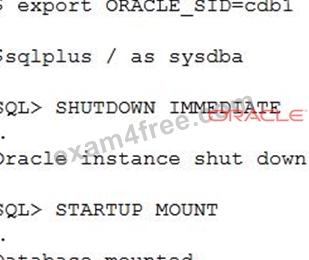
Which two are true? (Choose two.)
- A. CDB$ROOT is in MOUNT state.
- B. PDB1 and PDB2 are in MOUNT state.
- C. PDB1 and PDB2 are in READ ONLY state.
- D. PDB$SEED is in READ ONLY state.
- E. Redo logs are opened.
Answer: A,B
Explanation:
When a CDB is mounted, the CBD root is mounted, which means that the control files are opened, as well as the PDBs.
NEW QUESTION # 115
Choose three. You must migrate a non-CDB Oracle 11g Database to a CDB without first performing an upgrade to the non-CDB. User-defined objects are stored in several tablespaces in the non-CDB. Which three methods can you use?
- A. the DBMS_PDB package
- B. Data Pump full database export and import
- C. cloning the non-CDB as a PDB
- D. Data Pump full transportable database
- E. Data Pump transportable tablespaces
- F. replication using GoldenGate
Answer: A,B,C
NEW QUESTION # 116
Choose two. Which two are true about creating RMAN backups for an Oracle container database?
- A. The BACKUP TABLESPACE command can back up a PDB tablespace even if RMAN is connected to CDB$ROOT.
- B. Archived Redo Log backups can be created while connected to an application root CDB.
- C. Control file backups can be created while connected to a nonroot container.
- D. Online Redo Log backups can be created while connected to the root container.
- E. Control file backups can be created while connected to the root container.
Answer: A,E
NEW QUESTION # 117
Choose three. Which three are true about Recovery Manager (RMAN) active database duplication?
- A. The active database must be duplicated while in OPEN state.
- B. No connection to the recovery catalog is required for active database duplication.
- C. Image copies can be used to duplicate the active database.
- D. Pre-existing backups of the database to be duplicated are required for the "pull" method of duplication.
- E. Pre-existing backups of the database to be duplicated are always used if they exist.
- F. Backup sets can be used to duplicate the active database.
- G. Pre-existing backups of the database to be duplicated are required for the "push" method of duplication.
Answer: B,C,F
NEW QUESTION # 118
Which two are true about OS groups and users for Oracle Grid Infrastructure and the Oracle Relational Database Management System (RDBMS)? (Choose two.)
- A. The Oracle Grid Infrastructure owner must have OSOPER, OSBACKUPDBA, and OSKMDBA as secondary groups.
- B. By default, members of the OSASM group can access Automatic Storage Management and RDBMS instances.
- C. The same OSDBA group must be used for Automatic Storage Management and the Oracle Database.
- D. The primary group for the Oracle Grid Infrastructure and Oracle Database owners must be the Oracle Inventory group.
- E. The Oracle Grid Infrastructure installation must be owned by the grid user.
- F. The Oracle Grid Infrastructure owner owns Oracle Restart and Oracle Automatic Storage Management binaries.
Answer: A,C
NEW QUESTION # 119
Unified auditing is enabled in your database. The HR_ADMIN and OE_ADMIN roles exist and are granted system privileges. You execute the command: SQL>CREATE AUDIT POLICY table_aud PRIVILEGES CREATE ANY TABLE, DROP ANY TABLE ROLES hr_admin,oe_admin; Which statement is true?
- A. It fails because the command does notspecify when the unified audit policy should be enforced.
- B. It succeeds and needs to be enabled to capture all SQL statements that require either the specified privileges or any privilege granted to the HR_ADMIN or OE_ADMIN role.
- C. It succeeds and starts capturing only successful SQL statements for all users who have either the specified privileges or roles granted to them.
- D. It fails because system privileges cannot be granted with roles in the same audit policy.
Answer: B
NEW QUESTION # 120
Which three can be done using Oracle Database Configuration Assistant (DBCA) starting from Oracle Database 19c? (Choose three.)
- A. cloning a remote container database in silent mode
- B. cloning a remote pluggable database in silent mode
- C. cloning a remote container database in interactive mode
- D. relocating aremote container database in interactive mode
- E. relocating a remote pluggable database in silent mode
- F. relocating a remote pluggable database in interactive mode
- G. relocating a remote container database in silent mode
Answer: A,E,F
NEW QUESTION # 121
Which two are true about the Oracle database methodology? (Choose two.)
- A. Tuning activities should stop once the user is satisfied with performance.
- B. The Oracle Database time model should be used to find the database and instance areas most in need of tuning.
- C. SQL statements should always be tuned before tuning any file systems.
- D. The alert log should be used to find the database and instance areas most in need of tuning.
- E. The database instance memory should always be tuned before tuning any file systems.
- F. Tuning activities should stop once agreed service levels for performance have been met.
Answer: B,C
NEW QUESTION # 122
In which three situations can you use threshold server-generated alerts to help diagnose and fix problems? (Choose three.)
- A. when a resumable statement is suspended
- B. when the total number of locked user account exceeds a specific value
- C. when free space in a locally managed tablespace falls below a specified percentage
- D. when the number of logons per second exceeds a specific value
- E. when the total number of logons exceeds a specific value
- F. when free space in a dictionary managed tablespace falls below a specified percentage
Answer: B,D,F
NEW QUESTION # 123
......
Updated Oracle 1Z0-083 Dumps – PDF & Online Engine: https://www.exam4free.com/1Z0-083-valid-dumps.html
1Z0-083.pdf - Questions Answers PDF Sample Questions Reliable: https://drive.google.com/open?id=1wicgKQjC4ANbiMWjG1rLHZV4jhjMEWae
