
[Dec-2025] Valid Way To Pass Fortinet Exam Dumps with FCP_FAC_AD-6.5 Exam Study Guide
All FCP_FAC_AD-6.5 Dumps and FCP—FortiAuthenticator 6.5 Administrator Training Courses Help candidates to study and pass the Exams hassle-free!
NEW QUESTION # 28
Which two protocols are the default management access protocols for administrative access for FortiAuthenticator? (Choose two)
- A. SNMP
- B. HTTPS
- C. Telnet
- D. SSH
Answer: B,D
NEW QUESTION # 29
What is the primary purpose of a digital certificate in PKI?
- A. To store personal information of the certificate holder
- B. To encrypt all network traffic in a network environment
- C. To verify the identity of the certificate holder and enable secure communication
- D. To provide access to encrypted websites only
Answer: C
NEW QUESTION # 30
Which two data items are not synchronized in an active-active HA deployment? (Choose two.)
- A. FSSO events
- B. User certificates
- C. Seeds
- D. Group mappings
Answer: A,C
Explanation:
In an active-active HA deployment, FSSO events and seeds are not synchronized between FortiAuthenticator units, as these are instance-specific and typically handled locally on each node.
NEW QUESTION # 31
What is the benefit of using remote authentication services?
- A. They reduce the need for firewalls
- B. They replace the need for encryption protocols
- C. They increase network speed
- D. They enable secure access for users outside the corporate network
Answer: D
NEW QUESTION # 32
In FortiAuthenticator, what is the typical second factor used in two-factor authentication?
- A. User's password
- B. One-time password (OTP) generated by a token
- C. User's birthdate
- D. User's favorite color
Answer: B
NEW QUESTION # 33
What are three key features of FortiAuthenticator? (Choose three.)
- A. Log server
- B. RSSO server
- C. Identity management device
- D. Portal services
- E. Certificate authority
Answer: C,D,E
Explanation:
FortiAuthenticator functions as an identity management device, handling user authentication and authorization.
It provides portal services for user self-registration, guest management, and authentication portals.
It acts as a certificate authority, issuing and managing digital certificates for secure authentication.
NEW QUESTION # 34
Which three of the following can be used as SSO sources? (Choose three.)
- A. SSH sessions
- B. FortiClient SSO Mobility Agent
- C. RADIUS accounting
- D. FortiAuthenticator in SAML SP role
- E. FortiGate
Answer: B,C,E
Explanation:
RADIUS accounting can be used by FortiAuthenticator to obtain user identity and session details for SSO.
FortiClient SSO Mobility Agent reports user login events to FortiAuthenticator for SSO.
FortiGate can act as an SSO source by sending user authentication information to FortiAuthenticator.
NEW QUESTION # 35
Which component of a digital certificate contains information about the certificate holder's identity?
- A. Public key
- B. Private key
- C. Subject field
- D. Certificate Authority's signature
Answer: C
NEW QUESTION # 36
When configuring two-factor authentication (2FA) in FortiAuthenticator, which of the following factors can be used together?
- A. Something a user is and something a user does
- B. Two biometric factors
- C. Something a user has and something a user does
- D. Something a user knows and something a user has
Answer: D
NEW QUESTION # 37
When working with administrator profiles, which permission sets can be customized?
- A. Only the pre-existing permission sets can be customized.
- B. Only user-created or cloned permission sets can be customized.
- C. Only non-administrator permission sets can be customized.
- D. All permission sets can be customized.
Answer: B
NEW QUESTION # 38
What is the purpose of configuring administrative accounts and roles in FortiAuthenticator?
- A. To delegate specific administrative tasks to different users
- B. To allow only guest users to have administrative privileges
- C. To automatically generate passwords for all users
- D. To restrict all users from accessing the system
Answer: A
NEW QUESTION # 39
Which three factors can determine which RADIUS policy is matched during a RADIUS authentication? (Choose three.)
- A. RADIUS response
- B. Selected realm
- C. RADIUS client
- D. RADIUS attribute
- E. Policy ranking
Answer: C,D,E
NEW QUESTION # 40
In FortiAuthenticator, what is the purpose of a captive portal?
- A. To encrypt all network traffic for security
- B. To restrict user access to specific websites
- C. To capture and authenticate user credentials before granting access to the network
- D. To manage hardware resources in the network
Answer: C
NEW QUESTION # 41
What is the recommended strategy to ensure high availability for FortiAuthenticator?
- A. Implement a clustered configuration with multiple FortiAuthenticator units
- B. Use multiple authentication methods for each user
- C. Configure all users to have duplicate accounts
- D. Keep the system in standby mode at all times
Answer: A
NEW QUESTION # 42
How can tags be used to generate Fortinet Single Sign-On (FSSO) events?
- A. By attaching physical tags to users' devices
- B. By creating custom login screens
- C. By sending notifications to users about authentication events
- D. By automatically categorizing logon events using predefined labels
Answer: D
NEW QUESTION # 43
Which of the following is a recommended practice when configuring FortiAuthenticator for deployment?
- A. Disabling all authentication methods except one
- B. Enabling all available authentication methods for flexibility
- C. Disabling all user roles to simplify access control
- D. Using the default factory settings for quicker deployment
Answer: A
NEW QUESTION # 44
Refer to the exhibit.
FortiAuthenticator Topology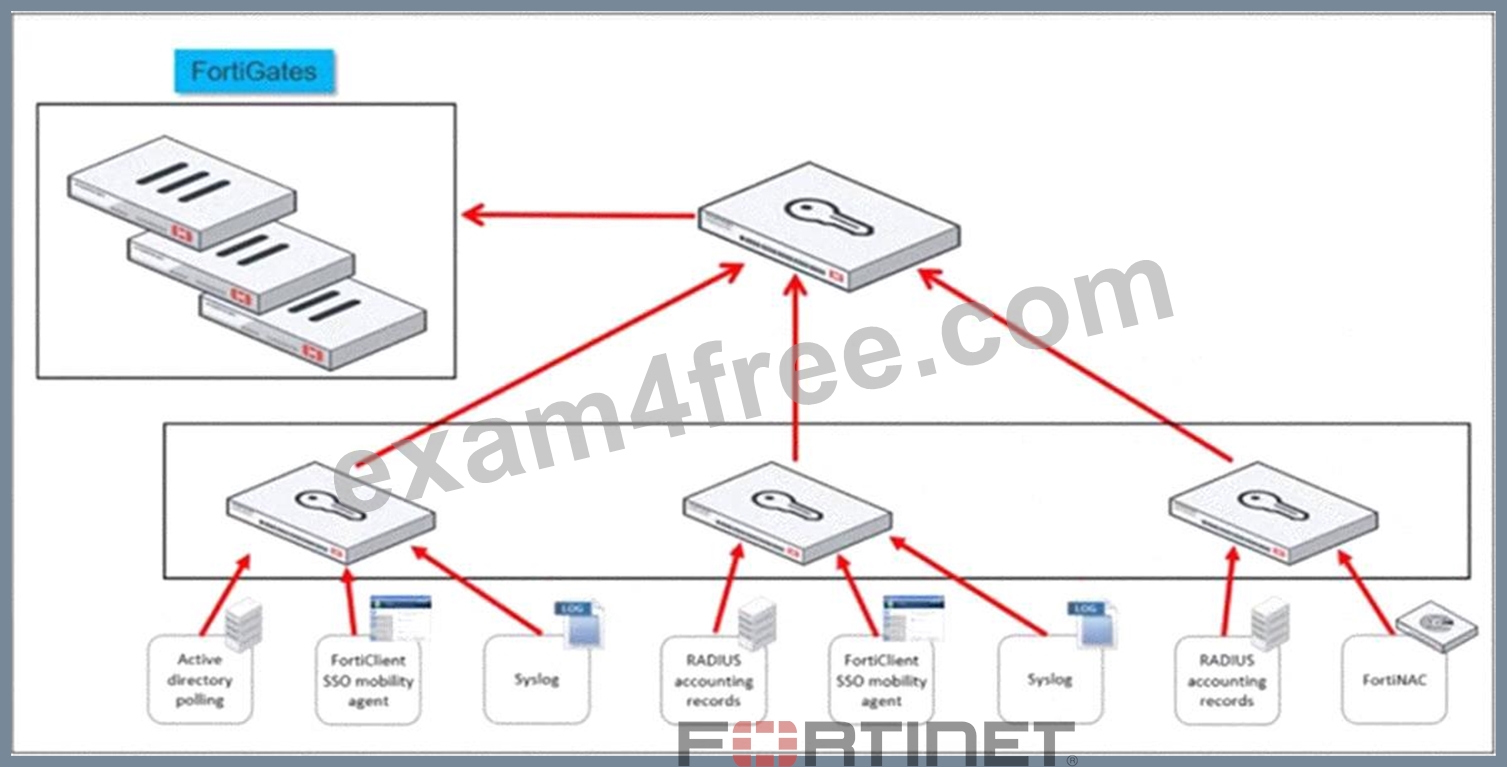
What type of FortiAuthenticator configuration is shown in this topology?
- A. Authentication load balancing nodes
- B. Tiered architecture
- C. Active-active HA
- D. RADIUS proxy
Answer: B
Explanation:
The diagram shows a tiered architecture where multiple FortiAuthenticator devices collect authentication data from various sources and forward it to an upper-tier FortiAuthenticator, which consolidates and provides SSO information to FortiGate devices.
NEW QUESTION # 45
Which statement about captive portal policies is true, assuming a single policy has been defined?
- A. All conditions in the policy must match before a user is presented with the captive portal.
- B. Portal policies apply only to authentication requests coming from unknown RADIUS clients
- C. Portal policies can be used only for BYODs.
- D. Conditions in the policy apply only to wireless users.
Answer: A
NEW QUESTION # 46
Which two SAML roles can Fortiauthenticator be configured as? (Choose two)
- A. Service provider
- B. Principal
- C. Idendity provider
- D. Assertion server
Answer: A,C
NEW QUESTION # 47
What does SAML stand for in the context of SAML SSO service?
- A. Security Assertion Markup Language
- B. Single Authentication Management Logic
- C. System Authorization and Management Layer
- D. Secure Access Markup Language
Answer: A
NEW QUESTION # 48
A device that is 802.1X non-compliant must be connected to the network.
Which authentication method can you use to authenticate the device with FortiAuthenticator?
- A. EAP-TLS
- B. EAP-TTLS
- C. Machine-based authentication
- D. MAC-based authentication
Answer: D
NEW QUESTION # 49
At a minimum, which two configurations are required to enable captive portal services on FortiAuthenticator?
(Choose two.)
- A. Configuring a portal policy
- B. Configuring a RADIUS client
- C. Configuring at least one pre-login service
- D. Configuring an external authentication portal
Answer: A,C
Explanation:
A pre-login service must be configured to define how users can access the portal before authentication.
A portal policy is required to determine authentication rules and behavior for captive portal access.
NEW QUESTION # 50
Why would you configure an OCSP responder URL in an end-entity certificate?
- A. To designate the SCEP server to use for CRL updates for that certificate
- B. To designate a server for certificate status checking
- C. To identify the end point that a certificate has been assigned to
- D. To provide the CRL location for the certificate
Answer: B
Explanation:
Configuring an OCSP responder URL in an end-entity certificate designates the server that will be queried to check the real-time revocation status of the certificate.
NEW QUESTION # 51
An administrator wants users and devices that cannot be identified transparently, such as Android BYOD devices, to be able to register and create their own credentials.
In this case, which FortiAuthenticator user identity discovery method can the administrator use?
- A. Portal authentication
- B. Syslog messaging or SAML IdP
- C. SSOMA
- D. Kerberos-based authentication
Answer: A
Explanation:
Portal authentication allows unidentified users or devices, such as Android BYOD devices, to self-register and create credentials through a captive or guest portal on FortiAuthenticator.
NEW QUESTION # 52
......
Real Exam Questions and Answers - Fortinet FCP_FAC_AD-6.5 Dump is Ready: https://drive.google.com/open?id=1gpHBPB25MRXzMRANZmOcEgFW_HBtaPu4
Get Latest [Dec-2025] Conduct effective penetration tests using Exam4Free FCP_FAC_AD-6.5: https://www.exam4free.com/FCP_FAC_AD-6.5-valid-dumps.html
