
[Full-Version] 2025 New Exam4Free JN0-481 PDF Recently Updated Questions
JN0-481 Exam with Guarantee Updated 78 Questions
NEW QUESTION # 42
Which statement about Juniper Apstra role-based access control is correct?
- A. The user role can create roles.
- B. The administrator role is the only predefined role.
- C. The administrator role can see all permissions.
- D. The viewer role is predefined and can be deleted.
Answer: C
Explanation:
Juniper Apstra role-based access control (RBAC) is a feature that allows you to specify access permissions for different users based on their roles. RBAC servers are remote network servers that authenticate and authorize network access based on roles assigned to individual users within an enterprise. Juniper Apstra has four predefined user roles: administrator, device_ztp, user, and viewer. The administrator role is the most powerful role, and it can see all permissions and perform all actions in the Apstra software application. The administrator role can also create, clone, edit, and delete user roles, except for the four predefined user roles, which cannot be modified. Therefore, the statement that the administrator role can see all permissions is correct.
NEW QUESTION # 43
In the Juniper Apstra design phase, which object dictates port count, port speed, and how the ports would be used?
- A. rack type
- B. interface map
- C. network devices
- D. logical devices
Answer: B
Explanation:
Interface maps are objects that map interfaces between logical devices and physical hardware devices in the Juniper Apstra design phase. They dictate port count, port speed, and how the ports would be used for achieving the intended network configuration rendering. Interface maps also allow you to select device ports, transformations, and interfaces, provision breakout ports, and disable unused ports.
NEW QUESTION # 44
You connect two single-homed servers using Juniper Apstra as shown in the exhibit. You are using the ERB design blueprint with two virtual networks in a common routing zone. In this scenario, which two types of VXLAN tunnels will be automatically created by the EVPN control plane? (Choose two.)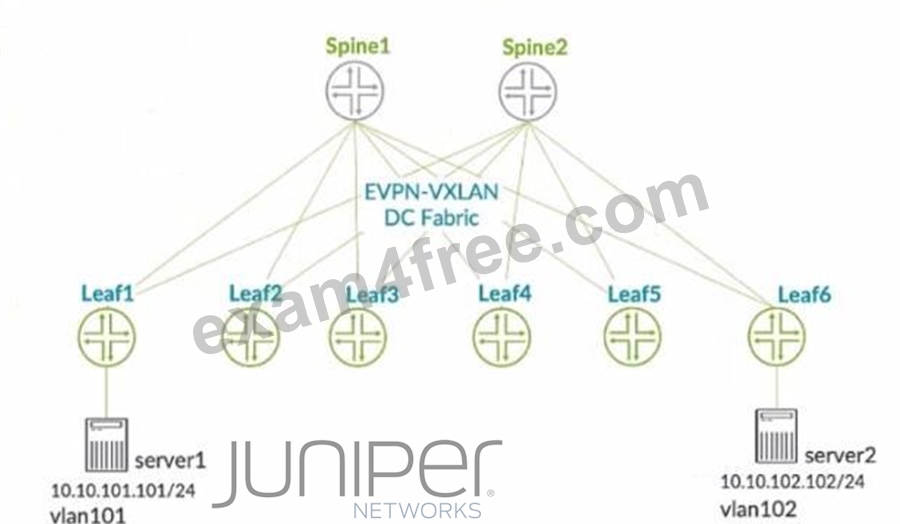
- A. EVPN signaled route Type-3 VXLAN tunnels
- B. EVPN signaled route Type-8 VXLAN tunnels
- C. EVPN signaled route Type-2 VXLAN tunnels
- D. EVPN signaled route Type-6 VXLAN tunnels
Answer: A,C
Explanation:
EVPN route Type-3 is used to advertise the IP address of the VTEP and the VNIs that it supports.
This allows the VTEPs to discover each other and form VXLAN tunnels for the VNIs that they have in common. EVPN route Type-2 is used to advertise the MAC and IP addresses of the hosts connected to the VTEPs. This allows the VTEPs to learn the MAC-to-IP bindings and the MAC-to- VTEP mappings for the hosts in the same VNI. Therefore, these two types of VXLAN tunnels will be automatically created by the EVPN control plane when using Juniper Apstra with the ERB design blueprint and two virtual networks in a common routing zone.
NEW QUESTION # 45
Referring to the exhibit, how many broadcast domains will an Ethernet frame pass through when traversing the IP fabric from Server A to Server B?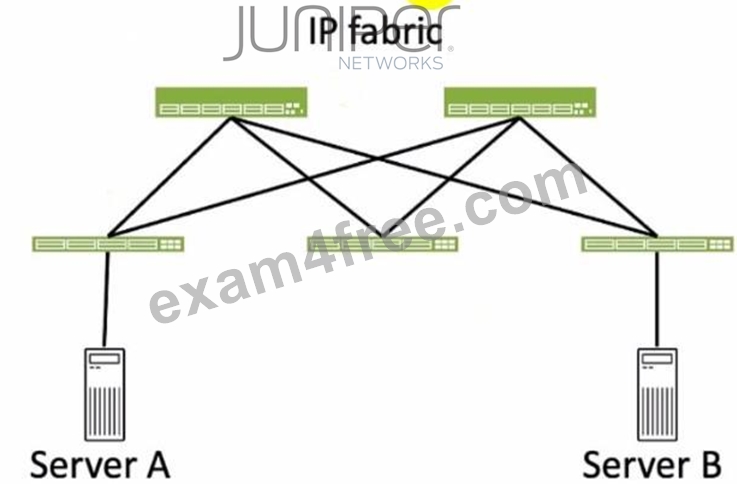
- A. 0
- B. 1
- C. 2
- D. 3
Answer: D
Explanation:
Referring to the exhibit, the image shows a simplified diagram of an IP fabric network connecting two servers, labeled as Server A and Server B. The IP fabric is a network architecture that uses a Clos topology to provide high bandwidth, low latency, and scalability for data center networks.
The IP fabric consists of spine and leaf devices that use BGP as the routing protocol and VXLAN as the overlay technology.
A broadcast domain is a logical portion of a network where any device can directly transmit broadcast frames to other devices at the data link layer (OSI Layer 2). A broadcast frame is a frame that has a destination MAC address of all ones (FF:FF:FF:FF:FF:FF), which means that it is intended for all devices in the same broadcast domain. A broadcast domain is usually bounded by a router, which does not forward broadcast frames to other networks.
In the exhibit, there are two broadcast domains that an Ethernet frame will pass through when traversing the IP fabric from Server A to Server B. The first broadcast domain is the one that contains Server A and the leaf device that it is connected to. The second broadcast domain is the one that contains Server B and the leaf device that it is connected to. The IP fabric itself is not a broadcast domain, because it uses IP routing and VXLAN encapsulation to transport the Ethernet frames over the Layer 3 network.
NEW QUESTION # 46
Referring to the exhibit, which role does Device A serve in an IP fabric?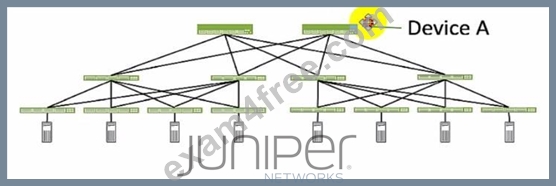
- A. leaf
- B. spine
- C. super spine
- D. server
Answer: B
Explanation:
Device A serves as a spine in an IP fabric. An IP fabric is a network architecture that uses a spine-leaf topology to provide high performance, scalability, and reliability for data center networks. A spine- leaf topology consists of two layers of devices: spine devices and leaf devices.
Spine devices are the core devices that interconnect all the leaf devices using equal-cost multipath (ECMP) routing. Leaf devices are the edge devices that connect to the servers, storage, or other network devices. In the exhibit, Device A is connected to four leaf devices using multiple links, which indicates that it is a spine device.
NEW QUESTION # 47
A member of your organization made changes to a predefined interface map using Juniper Apstra. Which two statements are correct in this scenario? (Choose two.)
- A. Any changes made to predefined interface maps are discarded when Apstra is upgraded.
- B. Changes to interface maps in the global catalog do not affect interface maps that have already been imported into blueprint catalogs
- C. Changes to interface maps in the global catalog will raise anomalies that may need to be addressed at the next commit.
- D. Changes made to predefined interface maps will not have an impact on the Apstra software.
Answer: A,B
Explanation:
An interface map is a configuration template that maps interfaces between logical devices and physical hardware devices (represented with device profiles) while adhering to vendor specifications. An interface map can be either predefined or custom. A predefined interface map is one that ships with Apstra software and supports most qualified Juniper devices. A custom interface map is one that is created by the user to meet specific requirements. An interface map can be stored in either the global catalog or the blueprint catalog. The global catalog contains all the interface maps that are available for use in any blueprint. The blueprint catalog contains the interface maps that are imported from the global catalog and used in a specific blueprint.
NEW QUESTION # 48
The 10.100.0.0/16 route is being advertised into your BGP IP fabric. ECMP load balancing has been properly enabled on all devices.
In this scenario, how many routes will the leaf device in AS 65000 receive for the 10.100.0.0/16 prefix?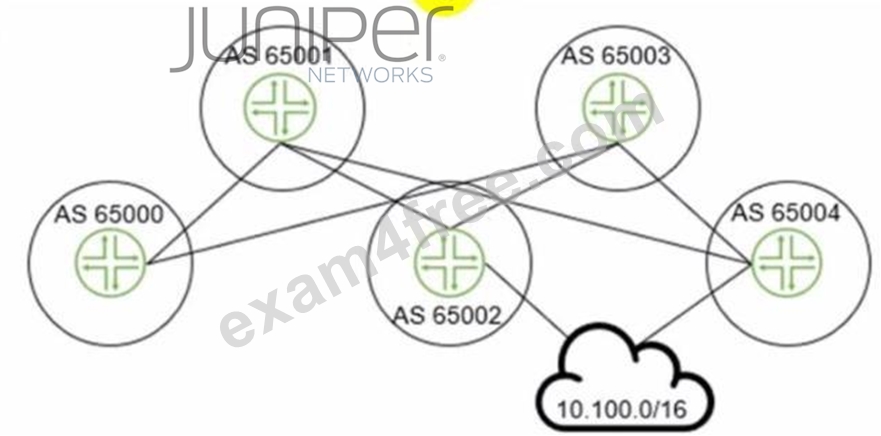
- A. 0
- B. 1
- C. 2
- D. 3
Answer: D
Explanation:
The leaf device in AS 65000 will receive three routes for the 10.100.0.0/16 prefix, one from each spine device in AS 65001, AS 65002, and AS 65003. Since ECMP load balancing is enabled, the leaf device will install all three routes in its routing table and distribute the traffic among them.
NEW QUESTION # 49
You are using Juniper Apstra to design a data center fabric. In this scenario, which object type associates a specific vendor model to a logical device?
- A. interface map
- B. device profiles
- C. templates
- D. agent profiles
Answer: B
Explanation:
Device profiles are objects that associate a specific vendor model to a logical device in Juniper Apstra. Device profiles contain extensive hardware model details, such as form factor, ASIC, CPU, RAM, ECMP limit, and supported features. Device profiles also define how configuration is generated, how telemetry commands are rendered, and how configuration is deployed on a device. Device profiles enable the Apstra system to render and deploy the configuration according to the Apstra Reference Design.
NEW QUESTION # 50
In Juniper Apstra. which three modes are available for devices? (Choose three.)
- A. Drain
- B. Stopped
- C. Ready
- D. Deploy
- E. Active
Answer: A,C,D
Explanation:
Juniper Apstra supports three deploy modes for devices: Deploy, Drain, and Ready. These modes determine the configuration and state of the devices in the data center fabric.
Deploy: This mode applies the full Apstra-rendered configuration to the device, according to the Apstra Reference Design. The device state becomes IS-ACTIVE and the device is ready to carry traffic in the fabric.
Drain: This mode adds a "drain" configuration to the device, which prevents any new traffic from entering the device. The device state becomes IS-READY and the device is prepared for maintenance or decommissioning.
Ready: This mode removes the Apstra-rendered configuration from the device, leaving only the basic configuration such as device hostname, interface descriptions, and port speed/breakout.
The device state becomes IS-READY and the device is not part of the fabric.
NEW QUESTION # 51
Which of the following two statements are correct?
- A. VXLAN encapsulation discards VLAN IDs
- B. VXLAN is a Layer 3 encapsulation protocol
- C. VXLAN is a Layer 2 encapsulation protocol
- D. VXLAN encapsulation discards VNIs
Answer: A,C
NEW QUESTION # 52
You must configure a static route for traffic to exit a configured routing zone. In the Juniper Apstra Ul, where would you accomplish this task?
- A. under Active -> Virtual -> Routing Zones
- B. under Active -> Connectivity Templates
- C. under Staged -> Connectivity Templates
- D. under Staged -> Virtual -> Routing Zones
Answer: C
Explanation:
To configure a static route for traffic to exit a configured routing zone, you need to use the Connectivity Templates feature in the Juniper Apstra UI. A Connectivity Template is a set of configuration parameters that can be applied to a device or a group of devices in a blueprint. You can use Connectivity Templates to configure static routes, BGP, OSPF, and other network services. To create a Connectivity Template, you need to go to the Staged tab and select Connectivity Templates from the left menu. Then, you can click on the + icon to create a new template. You can specify the name, description, and scope of the template. The scope determines which devices or device groups the template will be applied to. You can also specify the order of the template, which determines the priority of the template when multiple templates are applied to the same device. After creating the template, you can add configuration items to the template. To add a static route, you need to select Static Route from the drop-down menu and enter the destination network, subnet mask, and next- hop IP address. You can also specify the administrative distance and the track object for the static route. After adding the configuration items, you need to save the template and commit the changes to the blueprint.
NEW QUESTION # 53
What is one indicator in the Apstra UI that implies that changes to a blueprint are ready to be committed?
- A. The Staged tab turns yellow
- B. The Staged tab turns green
- C. Each assigned device has been set to Deploy mode.
- D. Interface maps have been assigned through Device Profiles.
Answer: B
NEW QUESTION # 54
What is the purpose of using a routing zone inside Juniper Apstra software?
- A. A routing zone defined at the Apstra manager level requires firewalls to be deployed.
- B. A routing zone is used to enable L4-L7 inspection inside the fabric.
- C. A routing zone is used to enable the communication between two VNIs within a VRF.
- D. A routing zone is defined to secure the routing protocols.
Answer: C
Explanation:
A routing zone is an L3 domain, the unit of tenancy in multi-tenant networks. You create routing zones for tenants to isolate their IP traffic from one another, thus enabling tenants to re-use IP subnets. In addition to being in its own VRF, each routing zone can be assigned its own DHCP relay server and external system connections. You can create one or more virtual networks within a routing zone, which means a tenant can stretch its L2 applications across multiple racks within its routing zone. For virtual networks with Layer 3 SVI, the SVI is associated with a Virtual Routing and Forwarding (VRF) instance for each routing zone isolating the virtual network SVI from other virtual network SVIs in other routing zones.
NEW QUESTION # 55
You want to add a configuration that is not supported by Juniper Apstra reference architecture using a configlet.
Which two configurations would be applicable in this scenario? (Choose two.)
- A. NTP configuration
- B. syslog configuration
- C. static route configuration
- D. policy configuration
Answer: A,B
Explanation:
A configlet is a configuration template that augments Apstra's reference design with non-native device configuration. They consist of one or more generators. Each generator specifies a NOS type (config style), when to render the configuration, and CLI commands (and file name as applicable).
Some applications for configlets include the following:
- Syslog
- SNMP access policy
- TACACS / RADIUS
- Management ACLs
- Control plane policing
- NTP
- Username / password
NEW QUESTION # 56
You want to keep virtual networks isolated from each other within the Juniper Apstra system. In this scenario, what are three ways to accomplish this task? (Choose three.)
- A. Disable IPv4 connectivity when creating the virtual network within the same Routing Zone.
- B. Use Connectivity Templates to block access within the same Routing Zone.
- C. Enable Security Policy for virtual networks in the same Routing Zone.
- D. Put each network in different Routing Zones.
- E. Disable Route Target exports when creating the Routing Zones.
Answer: B,C,D
Explanation:
To keep virtual networks isolated from each other within the Juniper Apstra system, you can use one or more of the following methods:
Enable Security Policy for virtual networks in the same Routing Zone. This allows you to define rules that control the traffic flow between different virtual networks within the same routing zone.
You can specify the source and destination virtual networks, the protocol, the port, and the action (allow or deny) for each rule. The security policy is applied on the ingress interface of the leaf devices.
Use Connectivity Templates to block access within the same Routing Zone. This allows you to customize the connectivity between different racks within the same routing zone. You can create templates that define the link type, the routing protocol, and the access control list (ACL) for each rack pair. The ACL can be used to filter the traffic based on the source and destination IP addresses, the protocol, and the port.
Put each network in different Routing Zones. This allows you to create logical boundaries between different virtual networks based on the route target (RT) values. A routing zone is a collection of virtual networks that share the same RT for importing and exporting routes. Virtual networks in different routing zones do not exchange routes with each other, unless you configure remote EVPN gateways to connect them.
NEW QUESTION # 57
Within Managed Devices in the Juniper Apstra Ul, you notice that several devices have the OOS- Quarantined status. The devices cannot be added to any blueprint. Which action would solve this problem?
- A. Upload a new pristine configuration.
- B. Fix the hardware issues with the quarantined devices.
- C. Install the agent, even though connectivity is established.
- D. Acknowledge the device.
Answer: D
Explanation:
When an agent installation is successful, devices are placed into the Out of Service Quarantined (OOS-QUARANTINED) state using the Juniper Apstra UI. This state means that the device is not yet managed by Apstra and has not been assigned to any blueprint. The device configuration at this point is called Pristine Config. To make the device ready for use in a blueprint, you need to acknowledge the device, which is a manual action that confirms the device identity and ownership. Acknowledging the device changes its status to Out of Service Ready (OOS- READY).
NEW QUESTION # 58
Referring to the exhibit, what is the minimum information you must add to create a new routing zone?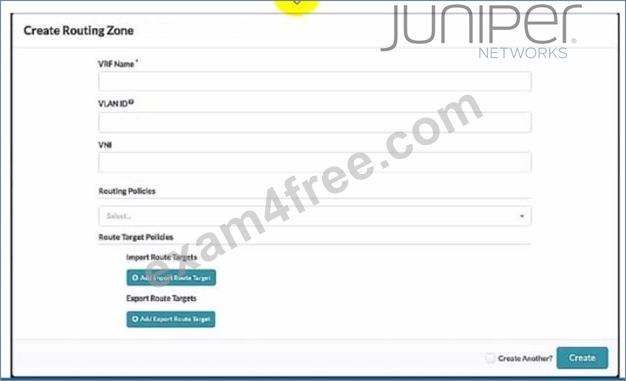
- A. VRF Name only
- B. VRF Name, VLAN ID, VNI, Routing Policies
- C. VRF Name, VLAN ID. And VNI
- D. VRF Name and Routing policies
Answer: C
Explanation:
To create a new routing zone, you must specify the VRF Name, VLAN ID, and VNI for the routing zone. These are the mandatory fields in the user interface shown in the exhibit. The VRF Name is the name of the L3 domain that isolates the IP traffic of the routing zone from other routing zones.
The VLAN ID is the identifier for the VLAN tagged Layer 3 links on external connections. The VNI is the VxLAN Network Identifier associated with the routing zone. The Routing Policies are optional fields that allow you to configure import and export route targets for the routing zone.
These are only applicable for EVPN routing zones, which use MP-EBGP as the overlay control protocol.
NEW QUESTION # 59
......
Latest JN0-481 Pass Guaranteed Exam Dumps Certification Sample Questions: https://www.exam4free.com/JN0-481-valid-dumps.html
JN0-481 Updated Exam Dumps [2025] Practice Valid Exam Dumps Question: https://drive.google.com/open?id=1Px4HZKsGo94Y5ZxCt4g6wAvqx-kftDn6
