
[Sep 26, 2025] Free Aruba Certified Professional - Campus Access HPE7-A06 Official Cert Guide PDF Download
HP HPE7-A06 Official Cert Guide PDF
NEW QUESTION # 21
An administrator is monitoringthird-party WLAN transmitters m HPE Aruba Networking Central and some of them are classified as rogue and suspected rogue How aresuspected rogues classified when using the default classification method for the rule "Suspected AP On-Prem" in HPE Aruba Networking Central?
- A. signal level = "-50 dbM" ANDWLAN classification = "On Wire"
- B. signal level ="-50 dbM" AND WLAN classification = "Interfering"
- C. signal level = '-65 dbM- AND WLAN classification ="On-Prem"
- D. signal level = "-55 dbM" AND WLAN classification =''Interfering"
Answer: C
Explanation:
The question asks how suspected rogue APs are classified using the default classification method for the
"Suspected AP On-Prem" rule in HPE Aruba Networking Central.
* Analysis of Options:
* Option A:Correct. Suspected rogues are classified with a signal level of -65 dBm (indicating proximity) and WLAN classification of "On-Prem" (indicating they are on the premises).
* Option B:Incorrect. A signal level of -55 dBm is too strong, and "Interfering" is not specific to on-premises rogues.
* Option C:Incorrect. A signal level of -50 dBm is even stronger, and "Interfering" is incorrect.
* Option D:Incorrect. "On Wire" classification applies to wired rogue detection, not wireless on- premises APs.
* Why Option A is Correct:In HPE Aruba Networking Central, the "Suspected AP On-Prem" rule identifies rogue APs based on their signal strength and location. A signal level of -65 dBm indicates the AP is close enough to be on the premises, and the "On-Prem" classification confirms it's detected within the managed network's environment. This default rule helps identify potential security threats by flagging unauthorized APs with moderate to strong signals, distinguishing them from interfering or distant APs, as per Aruba's wireless security framework.
* Relevance to Certification Objectives:
* WLAN (9%):Designing and troubleshooting RF attributes and wireless security functions.
* Security (10%):Troubleshooting and identifying rogue APs in customer networks.
* Troubleshooting (10%):Analyzing wireless issues using Aruba Central tools.
References:
HPE Aruba Networking Central User Guide: Rogue AP Detection and Classification.
HPE7-A06Study Guide: Covers wireless security and rogue AP management.
HPE Aruba Networking Technical Documentation: Wireless Security and Rogue Detection Best Practices.
NEW QUESTION # 22
Which issue may becausing the new door locks on the APs to notwork?
- A. AT power to the AP is notenough.
- B. AT power to the AP is too much.
- C. AF power to the AP is not enough.
- D. BT power to the AP is too much.
Answer: C
Explanation:
New PoE-powered door locks, connected via the PoE passthrough port on Aruba APs, are not working. We need to find the likely cause related to PoE power.
* PoE Passthrough:An AP feature where the AP, powered by PoE from a switch, provides PoE power out to another device connected to one of its Ethernet ports.
* Power Budget:The AP must receive enough power from the switch via its PoE input (e.g., 802.3af,
802.3at, 802.3bt) to power itselfandmeet the power demand of the downstream device (the door lock).
* PoE Standards Power (Approx. Available to Device):
* 802.3af (PoE): ~13 Watts
* 802.3at (PoE+): ~25.5 Watts
* 802.3bt (PoE++): 51W (Type 3) or 71W (Type 4)
* Analysis:Modern APs (especially Wi-Fi 6/6E) can consume significant power themselves (>15W or
>25W under load). Standard 802.3af PoE (supplying only ~13W) is often insufficient to power both a modern AP and a downstream PoE device like a door lock. The AP will power up, but won't enable PoE output if its input power budget is insufficient.
* Analysis of Options:
* A, B: Too much power (AT/BT) isn't the issue; devices only draw what they need.
* C: AF power (~13W) received by the AP is very likelynot enoughto power both the AP and the door lock.
* D: AT power (~25.5W)mightbe insufficient if the combined load of the AP and lock exceeds this, but AF being insufficient (C) is a more common limitation.
* Conclusion:Insufficient input power to the AP is the most common reason for PoE passthrough failure.
802.3af (PoE) power is often inadequate.
References:IEEE 802.3 PoE standards (af/at/bt), Aruba Access Point datasheets (PoE requirements, passthrough capabilities/budgets). This relates to "WLAN" (9%) and "Connectivity" (9%) objectives.
NEW QUESTION # 23
Refer to the exhibit.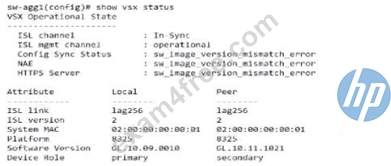
Based on the screenshot, what is required to bring the secondary switch MCLAO interfacesonline"?
- A. Use vsx-software-upgradeado on the secondary.
- B. Use the same ServiceOS version as on theprimary.
- C. Update the MAE agents on the secondary.
- D. Use the same CX OS version as on the primary.
Answer: D
Explanation:
The exhibit shows the output of show vsx status on sw-agg1. Key information includes:
* Config Sync Status : sw_image_version_mismatch_error
* NAE : sw_image_version_mismatch_error
* HTTPS Server : sw_image_version_mismatch_error
* Primary Software Version: GL.10.09.0010
* Secondary Software Version: GL.10.11.1021
These errors clearly indicate that the primary and secondary VSX switches are running different AOS-CX software versions. For VSX to operate correctly, including configuration synchronization and enabling features like MC-LAG interfaces, both switches in the pairmustrun the exact same software version.
* Analysis of Options:
* A: vsx-software-upgrade is used for upgrades but doesn't resolve the current mismatch requirement.
* B: NAE errors are a symptom of the underlying version mismatch.
* C: Using the same CX OS version on both primary and secondary switches is the fundamental requirement to clear the mismatch errors and achieve a stable VSX operational state.
* D: While ServiceOS is part of the system, the primary requirement and error message relate to the main AOS-CX software version.
References:AOS-CX VSX Guide (Chapter on VSX Requirements, Troubleshooting, Software Updates). This relates to "Network Resiliency and virtualization" (8%) and "Troubleshooting" (10%) objectives.
NEW QUESTION # 24
Acme is having BGP issues with its AOS-CX switch and has asked you to helptroubleshoot the issue You have access to the CLI ofthe switch. Which command can you use to begin troubleshooting?
- A. show debug destinations
- B. show run | route destination!
- C. snow buffer | debug
- D. show debug start
Answer: A
Explanation:
The question involves troubleshooting BGP issues on an AOS-CX switch, and the task is to identify the appropriate CLI command to begin the troubleshooting process.
* Analysis of Options:
* Option A (show run | route destination):Incorrect syntax; the show running-config command with a filter is not specific to BGP troubleshooting.
* Option B (show debug start):Incorrect; AOS-CX does not use show debug start for initiating debugging.
* Option C (show buffer | debug):Incorrect; this is not a valid AOS-CX command for BGP troubleshooting.
* Option D:Correct. The show debug destinations command displays the current debug settings, including whether BGP debugging is enabled, which is a critical first step in troubleshooting BGP issues.
* Why Option D is Correct:To troubleshoot BGP issues, the first step is to verify if debugging is enabled for BGP events, as this provides detailed logs of session states, messages, and errors. The show debug destinations command on AOS-CX switches shows which debug types (e.g., BGP) are active and where logs are sent (e.g., console, syslog). If BGP debugging is not enabled, the administrator can enable it using debug bgp to capture relevant information, making this the ideal starting point for BGP troubleshooting.
* Relevance to Certification Objectives:
* Troubleshooting (10%):Involves performing advanced troubleshooting of routing protocols like BGP.
* Routing (16%):Includes diagnosing BGP session and configuration issues.
References:
HPE Aruba Networking AOS-CX Configuration Guide: Debugging and Logging, detailing debug commands.
HPE7-A06Study Guide: Covers BGP troubleshooting workflows.
HPE Aruba Networking Technical Documentation: AOS-CX CLI Reference, explaining show debug destinations.
NEW QUESTION # 25
Exhibit.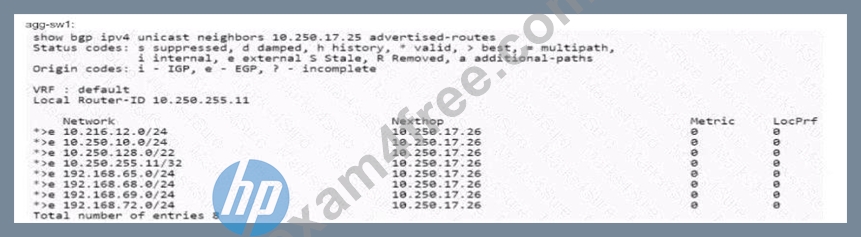
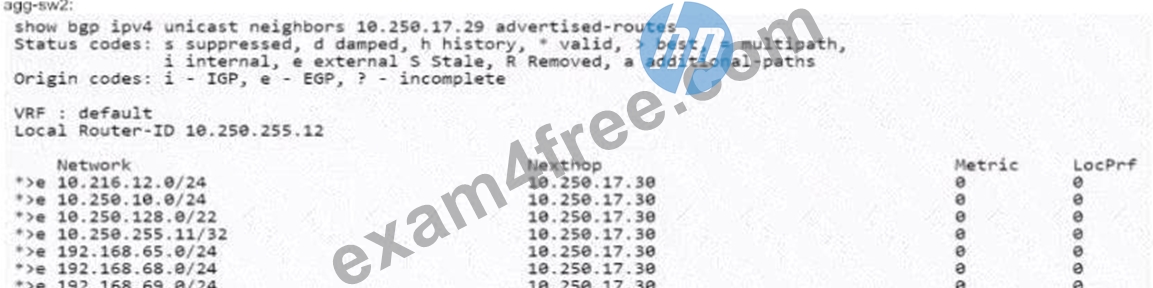
AGG-SW1 and AGG-SW2 are configured with iBGP and eBGP to AS65000. Both agg-sw1 and agg-sw2 useroute-map BGP-EXPORT and ip-prefix list local-export in the bgp configuration.
What must be done on agg-swl for the adjacent router to prefer to route all exported routes by agg-sw2?
- A. Add set as-path prepend 65345 65345 65345 65345 to the route-map BGP-EXPORT Match with local- export Ip prefix-list.
- B. Add set metric 200 to the route-map BGP-EXPORT.
- C. Add set local-preference 200 to the route-map BGP-EXPORT
- D. Add set as-path 65345 65345 65345 65345 to the route-map BGP-EXPORT Match with local-export ip prefix-list.
Answer: A
Explanation:
The goal is to make the adjacent router prefer routes exported by AGG-SW2 over AGG-SW1 for iBGP and eBGP routes to AS65000. Both switches use a route-map BGP-EXPORT with an ip-prefix list local-export.
BGP path selection uses attributes like local preference, AS path length, and metric to determine the preferred route.
* Analysis of Options:
* Option A:Setting local-preference 200 affects iBGP route selection within the same AS but has no impact on eBGP peers (external AS65000), as local preference is not advertised externally.
* Option B:Prepending the AS path with 65345 65345 65345 65345 increases the AS path length for routes exported by AGG-SW1, making them less preferred by the adjacent router (both iBGP and eBGP peers) compared to AGG-SW2's routes, which have a shorter AS path.
* Option C:Setting metric 200 affects the MED (Multi-Exit Discriminator), which is used for eBGP route selection within the same AS but is less influential than AS path length and not applicable for iBGP.
* Option D:Incorrect syntax (set as-path without prepend) and does not achieve the desired effect.
* Why Option B is Correct:BGP route selection prioritizes the shortest AS path for both iBGP and eBGP. By prepending AS 65345 multiple times to AGG-SW1's exported routes, AGG-SW1's routes appear less attractive due to a longer AS path, causing the adjacent router to prefer AGG-SW2's routes.
This is a standard BGP traffic engineering technique.
* Relevance to Certification Objectives:
* Routing (16%):Involves designing and troubleshooting BGP routing topologies, including manipulating path attributes like AS path.
* Troubleshooting (10%):Includes remediating BGP routing issues by adjusting route-maps.
References:
HPE Aruba Networking AOS-CX Configuration Guide: BGP Configuration, covering route-maps and AS path prepending.
HPE7-A06Study Guide: Details BGP path selection and traffic engineering.
HPE Aruba Networking Technical Documentation: BGP Route Manipulation, explaining AS path prepending for route preference.
NEW QUESTION # 26
Which command will permit read-only access to a user with physical access to an AOS-CS switch?
- A.

- B.

- C.

- D.

Answer: B
Explanation:
The question involves granting read-only access to a user with physical access to an AOS-CX switch. The task is to identify the correct command set.
* Analysis of Options (Assumed Context):Read-only access is typically configured using AAA with a privilege level or role. Option C is assumed to include commands like:
text
Copy
aaa authentication login privilege-mode
user operator password plaintext <password>
This assigns the "operator" role, which provides read-only access.
* Option A:Incorrect. Likely uses an incorrect role or privilege level (e.g., admin).
* Option B:Incorrect. May configure a role with excessive permissions or invalid syntax.
* Option C:Correct. Configures a user with the "operator" role for read-only access.
* Option D:Incorrect. Likely includes commands for a different access level or invalid configuration.
* Why Option C is Correct:In AOS-CX, the "operator" role provides read-only access, allowing users to view configurations and status (e.g., show commands) without modifying settings. The command user operator password plaintext <password> creates a local user with this role, and aaa authentication login privilege-mode ensures privilege levels are enforced upon login. This configuration is suitable for a user with physical access (e.g., via console or SSH), ensuring they cannot alter the switch, as per HPE Aruba Networking's AAA security practices.
* Relevance to Certification Objectives:
* Authentication/Authorization (9%):Configuring AAA for user access control.
* Security (10%):Implementing secure management access in customer networks.
* Troubleshooting (10%):Ensuring proper user permissions for network management.
References:
HPE Aruba Networking AOS-CX Configuration Guide: AAA Configuration, detailing user roles.
HPE7-A06Study Guide: Covers secure management access on AOS-CX switches.
HPE Aruba Networking Technical Documentation: AAA and User Role Best Practices.
NEW QUESTION # 27
A client would like to usetheHPE Aruba Networking Switch MultiEdit Software function in HPE Aruba Networking Central. Which option is available?
- A. Run the same NAE scripts for selected switches.
- B. Apply a configuration to an interface range for selected switches.
- C. Usetemplates and apply them to selected switches.
- D. Use CLI scripts and apply them to selected switches.
Answer: D
Explanation:
The question involves a client wanting to use the HPE Aruba Networking Switch Multi-Edit Software function in HPE Aruba Networking Central to manage multiple switches. The task is to identify the available option.
* Analysis of Options:
* Option A (Use templates and apply them to selected switches):Incorrect. Templates are used for configuration management in Central but are not part of the Multi-Edit Software function.
* Option B (Apply a configuration to an interface range for selected switches):Incorrect. Multi- Edit focuses on CLI scripting, not specifically interface range configurations.
* Option C (Run the same NAE scripts for selected switches):Incorrect. Network Analytics Engine (NAE) scripts are for monitoring, not configuration via Multi-Edit.
* Option D:Correct. Multi-Edit Software in Central allows administrators to apply CLI scripts to multiple selected switches for configuration changes.
* Why Option D is Correct:HPE Aruba Networking Central's Multi-Edit Software feature enables administrators to create and apply CLI scripts to multiple AOS-CX switches simultaneously, streamlining configuration tasks. This is particularly useful for bulk changes, such as VLAN configurations or policy updates, across selected switches. The feature supports direct CLI input or script uploads, ensuring consistent application of commands, as per HPE Aruba Networking's management tools. This aligns with the client's need for efficient multi-switch management.
* Relevance to Certification Objectives:
* Connectivity (9%):Developing configurations for multiple devices based on customer requirements.
* Troubleshooting (10%):Applying consistent configurations to resolve network issues.
* Network Stack (4%):Analyzing solutions for network management automation.
References:
HPE Aruba Networking Central User Guide: Multi-Edit Software Feature, detailing CLI script application.
HPE7-A06Study Guide: Covers network management tools in Central.
HPE Aruba Networking Technical Documentation: Multi-Edit Software Best Practices.
NEW QUESTION # 28
Refer to the exhibit.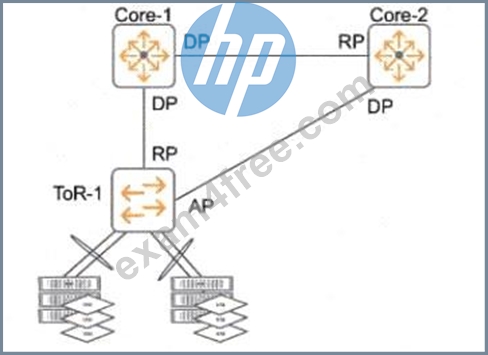
Acme Corp has VM workload running downstream of ToR-1 and has noticed performance degradation. They suspect ToR-1 uplinks are periodically over utilized. A partner has suggested you migrate your legacy 1U Coie-1 and Cote-2 to the CX 6400 series.
Which aspects of this platform would solve the customer's problem, while focusing on implementing HPE Aruba Networking best practices? (Select two.)
- A. The proposed new core's VSF capabilityallows multiple active forwarding pathways from ToR-1 based while eliminating the need for STP.
- B. The CX 6400 series supports multiple active forwardingpathways from ToR-1 based on multi-region design.
- C. MC-LAG permits Core-1 and Core-2 to present the edge 602.3ad device as a common system ID"
- D. The proposed solutions backplane stacking permits the directly connected ESXI hosts to load balance using active LACP.
Answer: A,C
Explanation:
The question involves a customer experiencing performance degradation due to periodic overutilization of ToR-1 uplinks to legacy Core-1 and Core-2 switches. The proposed solution is to migrate to CX 6400 series switches, and the task is to identify which aspects of the CX 6400 platform address the issue while adhering to HPE Aruba Networking best practices.
* Analysis of Options:
* Option A:Incorrect. The CX 6400 does not support "multi-region design" as a feature for active forwarding pathways.
* Option B:Correct. Virtual Switching Framework (VSF) on the CX 6400 allows multiple active forwarding pathways by creating a single logical switch from multiple physical switches, eliminating the need for STP in the core and reducing uplink congestion.
* Option C:Incorrect. Backplane stacking does not directly enable ESXi hosts to load balance using active LACP; this is unrelated to uplink utilization.
* Option D:Correct. Multi-Chassis Link Aggregation (MC-LAG) allows Core-1 and Core-2 to form a single logical 802.3ad (LACP) device, enabling active-active uplinks from ToR-1 and load balancing traffic to prevent overutilization.
* Why B and D are Correct:The performance degradation is caused by uplink overutilization, likely due to STP blocking redundant paths or inefficient load balancing. The CX 6400's VSF capability combines multiple switches into a single logical device, allowing all uplinks from ToR-1 to be active without relying on STP, which often blocks redundant paths. MC-LAG further enhances this by presenting Core-1 and Core-2 as a single LACP system, enabling ToR-1 to use all uplinks actively via LACP load balancing. These features align with HPE Aruba Networking best practices for high-availability and performance in campus core deployments.
* Relevance to Certification Objectives:
* Network Resiliency and Virtualization (8%):Designing and troubleshooting VSF and MC- LAG for resiliency and redundancy.
* Performance Optimization (6%):Analyzing and remediating uplink utilization issues.
* Connectivity (9%):Applying advanced networking architectures like VSF and MC-LAG.
References:
HPE Aruba Networking AOS-CX Configuration Guide: VSF and MC-LAG Configuration, detailing active forwarding and load balancing.
HPE7-A06Study Guide: Covers core switch resiliency and performance optimization.
HPE Aruba Networking Technical Documentation: CX 6400 Series Deployment Best Practices.
NEW QUESTION # 29
Exhibit.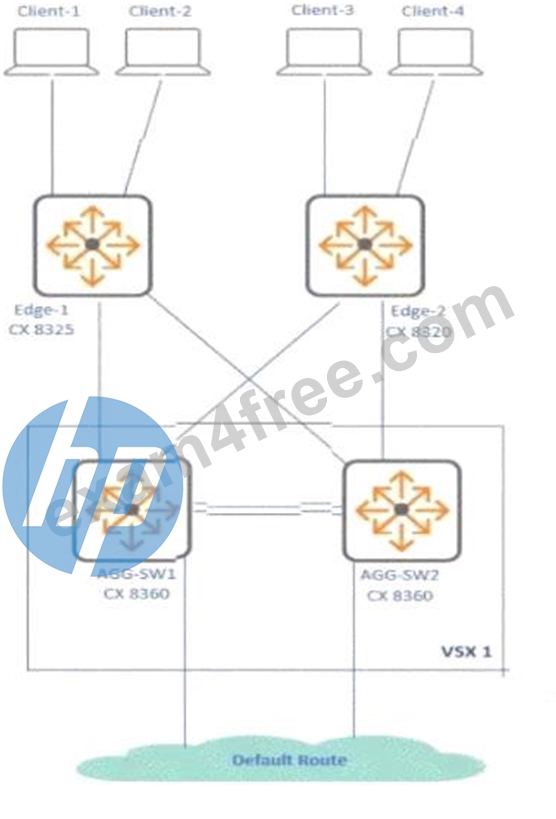
A conference venue has a requirement to secure independent network users from each other in their network.
The following configurations are created on Edge-1:
- A. change the VLAN 151 primary-vlan 151
- B. change the VLAN 152 type. primary-vlan 152
- C. change the VLAN 151 private-vlan community
- D. change the VLAN 152 private-vlan community
Answer: C
Explanation:
The requirement is to secure independent network users from each other in a conference venue using Edge-1.
This scenario typically calls for Private VLANs,specifically using the 'isolated' type to prevent communication between hosts within the same secondary VLAN.
* Analysis of Options:
* Private VLANs consist of a primary VLAN and one or more secondary VLANs (isolated or community). Isolated ports cannot communicate with other isolated ports in the same VLAN; they can only communicate with promiscuous ports (usually the router uplink). Community ports can communicate with each other and promiscuous ports.
* Option A: Configures VLAN 152 as private-vlan community.
* Option B: Configures VLAN 151 as private-vlan community.
* Option C: Defines VLAN 152 as a primary-vlan associated with itself, which isn't standard syntax
/logic.
* Option D: Defines VLAN 151 as a primary-vlan associated with itself.
* The goal isisolation. None of the options directly configure an isolated VLAN. Options A and B configure community VLANs, which allow communication between users within that VLAN, contradicting the requirement. Options C and D attempt to define primary VLANs in a potentially incorrect way.
* Caveat:There seems to be an issue with the provided options. Standard configuration to make VLAN 151 isolated would involve defining a primary VLAN (e.g., vlan 152 private-vlan primary) and then defining VLAN 151 as isolated (vlan 151 private-vlan isolated). Since none of the options correctly configure anisolatedVLAN, and the requirement is isolation, the question or options are likely flawed. However, if forced to interpret intent, questions sometimes test understanding of thetypesof private VLANs. Changing a VLANtocommunity type (Option B for VLAN 151) is a distinct action, even if it doesn't meet the statedisolationgoal. Without correct options for 'isolated', selecting the 'best' flawed option is difficult. Assuming the question intends to configure VLAN 151 assome typeof private secondary VLAN, Option B modifies VLAN 151's private VLAN characteristic.
* Conclusion:Based on the requirement for isolation, none of the provided options are correct. However, if assuming a potential error in the question or options and needing to select the closest modification related to private VLAN types for VLAN 151, Option B is chosen tentatively, despite configuring
'community' instead of the required 'isolated'.
References:AOS-CX Security Guide (Private VLAN configuration), Private VLAN concepts (Primary, Isolated, Community). This relates to the "Switching" (19%) and "Security" (10%) objectives.
NEW QUESTION # 30
A pair of CX 8325 series switches a configured in a VSX cluster. Which function is executed on both VSX members during normal operation?
- A. periodically sends gratuitous ARP and broadcast hello packets
- B. relays DHCP requests or serves DHCP offer
- C. replies to ARP requests with thecluster vMAC
- D. routes PIM and PIM-DR
Answer: C
Explanation:
The question asks which function is executed on both VSX members (CX 8325 switches) during normal operation in a VSX cluster.
* Analysis of Options:
* Option A:Correct. Both VSX switches reply to ARP requests with the cluster's virtual MAC (vMAC) for SVIs configured with active-gateway, ensuring consistent Layer 3 forwarding.
* Option B:Incorrect. PIM (Protocol Independent Multicast) and PIM-DR roles are typically handled by one switch, not both, in a VSX cluster.
* Option C:Incorrect. DHCP relay or server functions are not necessarily performed by both switches simultaneously.
* Option D:Incorrect. Gratuitous ARP and broadcast hello packets are typically sent by the primary switch or specific protocols, not both VSX members for all cases.
* Why Option A is Correct:In a VSX cluster, the active-gateway feature allows both switches to respond to ARP requests for Switched Virtual Interfaces (SVIs) using a shared virtual MAC address (vMAC). This ensures seamless Layer 3 forwarding and high availability, as clients receive consistent ARP replies regardless of which VSX switch processes the request. The vsx-sync feature ensures the vMAC is synchronized, enabling both switches to perform this function during normal operation, as per HPE Aruba Networking's VSX architecture.
* Relevance to Certification Objectives:
* Network Resiliency and Virtualization (8%):Designing and troubleshooting VSX for redundancy and active-active forwarding.
* Switching (19%):Implementing Layer 2/3 technologies, including ARP handling in VSX.
* Routing (16%):Ensuring consistent Layer 3 operations in VSX environments.
References:
HPE Aruba Networking AOS-CX Configuration Guide: VSX Configuration, detailing active-gateway and vMAC usage.
HPE7-A06Study Guide: Covers VSX Layer 3 functions and ARP handling.
HPE Aruba Networking Technical Documentation: VSX Active-Gateway Best Practices.
NEW QUESTION # 31
Exhibit.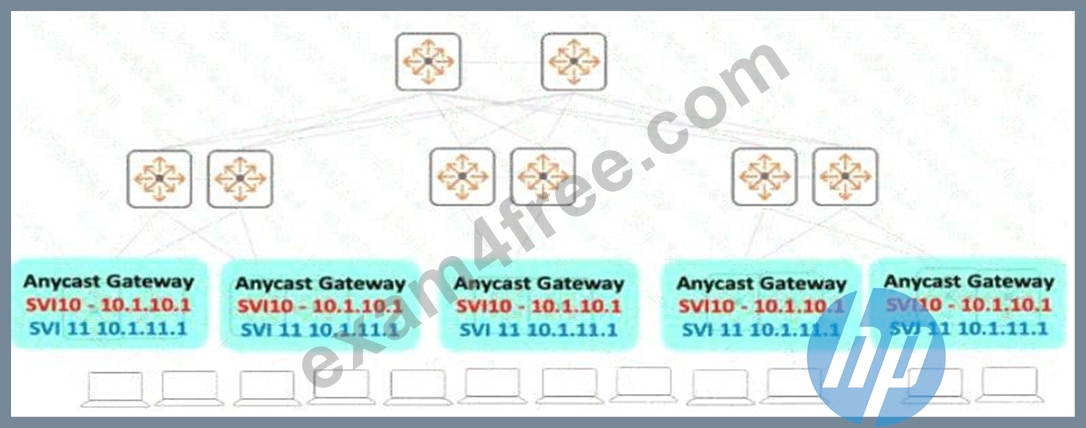
After Implementing a distributed overlay with distributed anycast gateways, you noticed that toomany ARP packets are being replicated to every access (leaf) switch Which command can you use to optimize the network?
- A. vlan 10 arp-suppression vlan 11 arp-suppression
- B. interface vlan 10 ip proxy-arp interface vlan 11 ip proxy-arp
- C. evpn arp-suppression
- D. evpn ip proxy-arp
Answer: C
Explanation:
In an EVPN VXLAN distributed overlay network, excessive ARP packet replication (flooding) to all leaf switches is observed. We need the command to optimize this.
* EVPN ARP Optimization:EVPN uses its control plane (BGP) to distribute MAC and IP address reachability information. Leaf switches (VTEPs) learn these mappings. To reduce ARP flooding across the VXLAN fabric:
* ARP Suppression:VTEPs intercept ARP requests. If the VTEP already knows the MAC address for the requested IP (learned via EVPN), it can suppress the ARP request, preventing it from being flooded over VXLAN.
* Proxy ARP:VTEPs intercept ARP requests. If the VTEP knows the MAC for the requested IP, it can generate an ARP replyon behalfof the remote host.
* AOS-CX Commands:These features are configured within the EVPN context.
* evpn arp-suppression (B): Enables the ARP suppression feature for EVPN.
* evpn ip proxy-arp (C): Enables the proxy ARP feature for EVPN.
* Options A and D use standard interface/VLAN level arp-suppression or proxy-arp commands, which are not specific to optimizing flooding within the EVPN VXLAN fabric itself.
* Conclusion:To optimize by reducing the replication/flooding of ARP packets across the EVPN VXLAN overlay, enabling evpn arp-suppression (Option B) is the direct command. This leverages the EVPN control plane knowledge to stop unnecessary ARP flooding.
References:AOS-CX EVPN Configuration Guide (ARP Suppression, Proxy ARP features). This relates to
"Switching" (19%) and "Routing" (16%) objectives in the context of overlays.
NEW QUESTION # 32
Exhibit.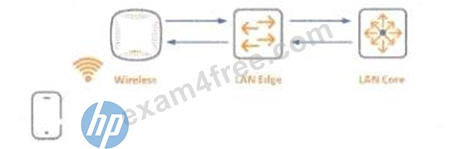
An end-to-end QoS design needs to be Implemented for wired and wireless. What is needed on the LAN side to maintain the correct DSCP tags?
- A. to create a WMM to DSCP mapping on the LAN Edge
- B. to trust at DSCP-marked packetsin the QoS interior ports
- C. tocreate a WMM la DSCP mapping on the WLAN side
- D. to create a custom DSCP mapping as WLAN DSCP values are different
Answer: B
NEW QUESTION # 33
Which EAP methods arc supported when configuring The 802.1X supplicant feature on an AOS-CX switch?
(Selecttwo.)
- A. EAP-MD5
- B. EAP-PEAP
- C. EAP-TLS
- D. EAP-TTLS
- E. EAP-TEAP
Answer: B,C
Explanation:
The question asks which EAP (Extensible Authentication Protocol) methods are supported when configuring the 802.1Xsupplicantfeature on an AOS-CX switch (i.e., the switch acting as the client authenticating to another device).
* AOS-CX 802.1X Supplicant:Allows the switch itself to authenticate using 802.1X.
* Supported EAP Methods:Switch implementations typically support a subset of common EAP methods for the supplicant role. Secure methods are preferred. AOS-CX documentation for the dot1x supplicant eap-method command typically lists supported types. Common secure methods found in documentation include EAP-TLS and EAP-PEAP (usually with MSCHAPv2). EAP-MD5 is often supported but insecure.
* Analysis of Options (Select Two):
* A. EAP-TLS: A secure, certificate-based method commonly supported by enterprise supplicants.
Likely supported.
* B. EAP-TTLS: Another secure tunneled method, but PEAP is sometimes more common in switch supplicants. Support needs verification in specific AOS-CX docs.
* C. EAP-MD5: Simple challenge-response, but insecure. Often supported for legacy reasons.
* D. EAP-PEAP: Secure tunneled method using server-side certificate and typically username
/password (MSCHAPv2) inside. Commonly supported.
* E. EAP-TEAP: A newer tunneled method, less likely to be supported than PEAP/TLS in switch supplicants.
* Conclusion:Based on typical enterprise requirements and likely AOS-CX capabilities documented for the supplicant feature, the secure methods EAP-TLS(A) and EAP-PEAP (D) are the most probable supported options among the choices.
References:AOS-CX Security Guide (802.1X Supplicant configuration, supported EAP methods). This relates to "Security" (10%) and "Authentication/Authorization" (9%).
NEW QUESTION # 34
Refer to the exhibit.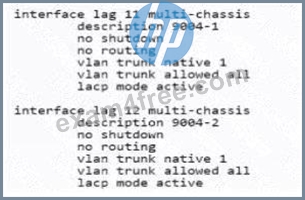
A gateway cluster needs to be connected to the VSX-enabled switches where MC-LAG is configured What Is a possible constraint?
- A. LLDP needs to be enabled to detect LACP-configured interfaces.
- B. lacp mode active needs to be configured on the gateways when usingstatic-activate" mode.
- C. The command lacp fallback is missing on the interface lag level.
- D. LACP is not supported during the initial provisioning and needs to be turned off.
Answer: D
Explanation:
The question asks about a possible constraint when connecting an Aruba Gateway Cluster to upstream VSX switches using an MC-LAG.
* Scenario:Gateway Cluster acts as a single logical device forming an LACP LAG. The VSX switches are configured with MC-LAG, allowing the gateway cluster to bundle links across the two physical VSX switches.
* LACP & Initial Provisioning:LACP requires negotiation (exchange of LACP PDUs) between both ends of the link bundle to activate the LAG. During initial gateway provisioning (ZTP, OTP), the gateway might be in a minimal state without its full configuration, including LACP parameters. If the VSX switch ports are configured strictly for LACP active mode, the LAG might not form until the gateway is fully provisioned and running LACP. This lack of connectivity during provisioning is a constraint.
* Analysis of Options:
* A: lacp mode active is standard, but the issue is during provisioning, not runtime mode choice.
"static-activate" is unrelated.
* B: Theabsenceof lacp fallback could be the constraint. Fallback allows connectivity if LACP doesn't establish, which is useful during provisioning.
* C: LLDP is not required for LACP.
* D: Correctly identifies the constraint: Standard LACP required by the switch might not be supported or active on the gateway during its initial provisioning phase, potentially hindering the setup process. Workarounds like disabling LACP or enabling LACP fallback on the switch ports during this phase are often necessary.
* Conclusion:LACP incompatibility during the initial provisioning phase of the gateway cluster is a common constraint when connecting to switches requiring LACP for the LAG.
References:Aruba Gateway Installation Guides, AOS-CX MC-LAG Configuration Guide, LACP Standard (IEEE 802.3ad). This relates to "Connectivity" (9%) and "Network Resiliency and virtualization" (8%).
NEW QUESTION # 35
An IT administrator uses AOS-CX switches to send TCP 22 trafficfrom the switch port to a remoteserver for analysis. The administrator now wants to save it locally tobedownloaded and used later in case the admin changes their mind about the approach to take.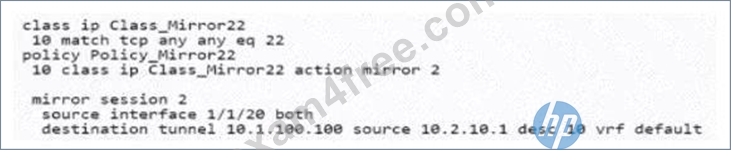
- A. destination flash:/.'my-mirror.pcnap policy Policy Minor22
- B. destination cpu
- C. destination file tshatk-pcap
- D. destination tunnel file tshark-pcpap
Answer: C
Explanation:
The question involves an AOS-CX switch administrator using a packet capture (e.g., tshark) to monitor TCP port 22 traffic and wanting to save it locally for later download, instead of sending it to a remote server.
* Analysis of Options:
* Option A:Correct. The destination file tshark-pcap command specifies that the packet capture output is saved to a local file (e.g., tshark-pcap) on the switch's flash storage.
* Option B:Incorrect. destination tunnel file tshark-pcpap is not a valid AOS-CX command for local storage.
* Option C:Incorrect. destination cpu is not relevant for saving packet captures; it may refer to CPU-based monitoring.
* Option D:Incorrect. destination flash:/.'my-mirror.pcnap policy Policy Minor22 has invalid syntax and does not align with packet capture storage.
* Why Option A is Correct:In AOS-CX, packet captures can be configured using the monitor command (e.g., monitor session 1 source interface 1/1/1 destination file tshark-pcap). The destination file tshark- pcap option saves the captured packets (e.g., TCP port 22 traffic) to a local file on the switch's flash storage, which can be downloaded later via SCP, SFTP, or the Web UI. This meets the administrator's requirement to store the capture locally for future analysis, aligning with AOS-CX's packet capture capabilities.
* Relevance to Certification Objectives:
* Troubleshooting (10%):Performing advanced troubleshooting using packet captures.
* Performance Optimization (6%):Analyzing network traffic for performance issues.
* Connectivity (9%):Diagnosing connectivity issues with monitoring tools.
References:
HPE Aruba Networking AOS-CX Configuration Guide: Packet Capture and Monitoring, detailing file-based captures.
HPE7-A06Study Guide: Covers troubleshooting with packet analysis tools.
HPE Aruba Networking Technical Documentation: AOS-CX Packet Capture Best Practices.
NEW QUESTION # 36
A customer is trialing the below colorless port configuration on a single switch and has noticed that users roaming to access points connected to the test switch are unable to receive an IP address on the corporate Wi- R network, which is operating in bridged mode All other SSIDs are working as expected and the AP is Online in HPE Aruba Networking Central.
The security team reports that there have been no failed authentications m HPE Aruba Networking ClearPass Access Tracker and that the last entry for the wiredport is returning the KADIUS Aruba-User-Hold attribute
'Access_Point.
Which configuration change is required to resolve the issue?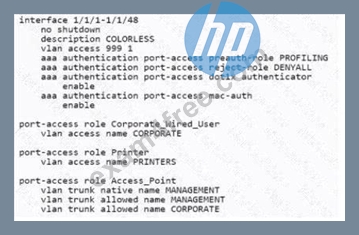
- A. port-access client-move enable
- B. interface 1/1/1-1/1/48
aaa authentication port-access client-limited 0 - C. interface 1/1/1/1-1/48
port-access onboarding-method concurrent enable - D. port access role Access_point auth-mode device-mode
Answer: B
Explanation:
The issue involves users roaming to APs connected to a test switch failing to receive an IP address on the corporate Wi-Fi network (bridged mode), with ClearPass reporting a RADIUS Aruba-User-Role attribute of Access_Point. The goal is to identify the configuration change needed to resolve this issue.
* Analysis of Options:
* Option A (port-access client-move enable):Enables client movement between ports but does not address the AP authentication issue.
* Option B (aaa authentication port-access client-limit 0):Correct. Setting the client limit to 0 on the switch ports (1/1/1-1/1/48) disables MAC authentication for APs, allowing them to be treated as trusted devices and preventing the application of an incorrect role.
* Option C (port-access onboarding-method concurrent enable):Enables concurrent onboarding but is unrelated to the AP role issue.
* Option D (port-access role Access_point auth-mode device-mode):Configures a device mode role but does not resolve the IP assignment issue caused by incorrect authentication.
* Why Option B is Correct:The issue arises because the switch is applying 802.1X or MAC authentication to the AP ports, resulting in ClearPass assigning the Access_Point role, which restricts client connectivity. By setting aaa authentication port-access client-limit 0 on the AP-connected ports (1
/1/1-1/1/48), the switch disables port-access authentication for these ports, treating the APs as trusted devices. This allows clients to authenticate properly via the AP and receive IP addresses in bridged mode, resolving the issue.
* Relevance to Certification Objectives:
* WLAN (9%):Involves troubleshooting wireless functions and Layer 2 issues related to AP connectivity.
* Authentication/Authorization (9%):Includes troubleshooting ClearPass integration and 802.1X configurations.
* Security (10%):Covers troubleshooting wired 802.1X implementations.
References:
HPE Aruba Networking AOS-CX Configuration Guide: Port Access Authentication, detailing client-limit configuration.
HPE7-A06Study Guide: Covers ClearPass integration and AP authentication troubleshooting.
HPE Aruba Networking Technical Documentation: Dynamic Segmentation and Port Access Security.
NEW QUESTION # 37
Match each BGP element to its description.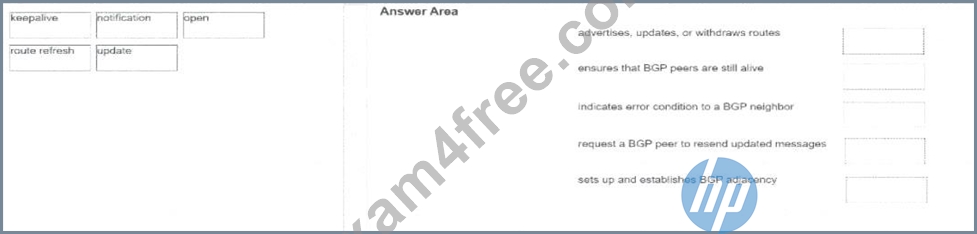
Answer:
Explanation: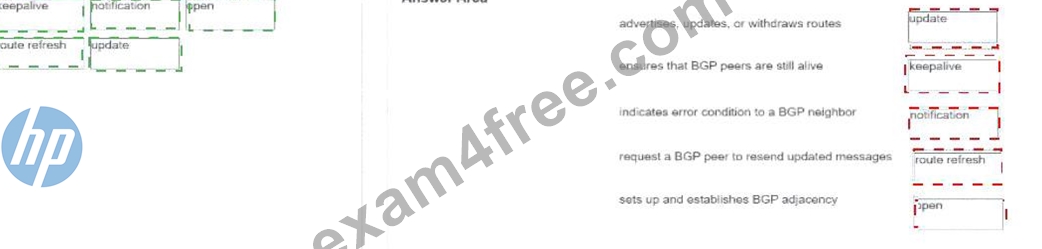
Explanation: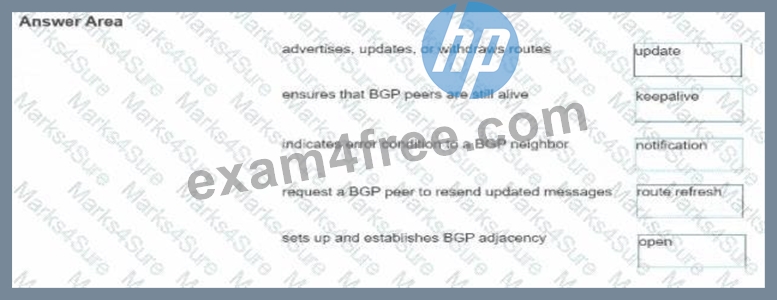
This question requires matching BGP protocol elements (mostly message types) to their primary function or description.
* OPEN Message:This is the first message sent after the TCP connection is established between BGP peers. Routers exchange OPEN messages to negotiate session parameters (AS Number, Hold Time, Router ID, Capabilities). A successful exchange leads to session establishment.
* Matches:"sets up and establishes BGP adjacency"
* UPDATE Message:This message is used to communicate network reachability information (NLRI). It carries prefixes that are being advertised, path attributes associated with those prefixes, and/or prefixes that are being withdrawn.
* Matches:"advertises, updates, or withdraws routes"
* KEEPALIVE Message:These messages are sent periodically between BGP peers within the agreed- upon Hold Time interval. Their primary purpose is to confirm that the peer is still alive and the session is active, especially when there are no UPDATE messages to send.
* Matches:"ensures that BGP peers are still alive"
* NOTIFICATION Message:This message is sent when a BGP error condition is detected (e.g., malformed message, unacceptable parameters in an OPEN message, hold timer expiry). Sending or receiving a NOTIFICATION message immediately causes the BGP session to terminate.
* Matches:"indicates error condition to a BGP neighbor"
* Route Refresh:This is a BGP capability (defined in RFC 2918) that allows a BGP speaker to request its peer to resend its routing updates for a specific address family, typically used after a policy change without requiring a full BGP session reset.
* Matches:"request a BGP peer to resend updated messages"
References:RFC 4271 (BGP4 Specification - Section 4, Messages), RFC 2918 (BGP Route Refresh Capability). This relates to the "Routing" (16%) objective.
NEW QUESTION # 38
......
Free HPE7-A06 Exam Dumps to Improve Exam Score: https://www.exam4free.com/HPE7-A06-valid-dumps.html
Exam HPE7-A06: New Brain Dump Professional - Exam4Free: https://drive.google.com/open?id=1RjdB5LTQr12syyVBd3P7lPBiDEfUcyWA
