
VCAP-DCV Design 3V0-21.23 Real Exam Questions and Answers FREE Updated on Apr 08, 2026
3V0-21.23 Ultimate Study Guide - Exam4Free
NEW QUESTION # 53
What are two valid use cases for VMware Cloud Foundation remote clusters? (Choose two.)
- A. Transform virtual machines to vSphere with Tanzu containers.
- B. Provide disaster recovery for an existing workload domain.
- C. Deploy a cluster within the same rack as the central VMware Cloud Foundation instance.
- D. Provide resources for virtual machines at an edge location.
- E. Enable vSphere with Tanzu on a cluster deployed at a remote location.
Answer: D,E
Explanation:
Enable vSphere with Tanzu on a cluster deployed at a remote location.
VMware Cloud Foundation remote clusters can be deployed to extend the functionality of vSphere with Tanzu to remote locations. This allows for containerized workloads to be managed and orchestrated using the same tools as the primary environment, providing consistent management of Tanzu clusters across multiple sites.
Provide resources for virtual machines at an edge location.
Remote clusters can be deployed at edge locations to provide computing resources for workloads that need to run close to the data source. This use case is particularly useful for applications that require low latency or need to process data locally before sending it to the central cloud infrastructure.
NEW QUESTION # 54
An architect is designing a new vSphere solution. The solution will be used to host workloads that have multiple dependencies. The customer provides the following information regarding the workloads:
Workload 1: Self-Service Portal
Workload 2: Database
Workload 3: Identity Broker
Workload 4: Reporting Tool
Workload 5: Management Tool
Application A is formed of workloads 1 and 2 and has a dependency on workload 3 Application B is formed of workloads 2 and 4 and has a dependency on workload 3 Application C is formed of workload 5 and has a dependency on workload 4 How should the architect document the vSphere HA requirements to ensure that all of the applications can be recovered in the event of a host failure while observing the dependencies?
- A. Set vSphere HA to Restart VMs in response to a Host FailureSet the Restart Priority of workload 3 to HighSet the Restart Priority of workload 4 to MediumSet the Restart Priority of workloads 1, 2 and 5 to Low
- B. Set vSphere HA to Shut Down and Restart VMs in response to a Host IsolationSet the Restart Priority of workload 3 to HighSet the Restart Priority of workloads 4 and 5 to MediumSet the Restart Priority of workloads 1 and 2 to Low
- C. Set vSphere HA to Shut Down and Restart VMs in response to a Host IsolationSet the Restart Priority of workloads 3 and 4 to HighSet the Restart Priority of workload 5 to MediumSet the Restart Priority of workloads 1 and 2 to Low
- D. Set vSphere HA to Restart VMs in response to a Host FailureSet the Restart Priority of workloads 3 and
4 to HighSet the Restart Priority of workload 5 to MediumSet the Restart Priority of workloads 1 and 2 to Low
Answer: A
NEW QUESTION # 55
An architect is tasked with an application migration to a new VMware Cloud platform. The application service owner assistance from the architect to identify the technical requirements of the application.
The following has been made available following initial discussions:
A VMware Aria Operations report containing current resource usage
The output from a planning session including a roadmap for planned service growth A service dependency map from the company's IT operations management tool The desired consolidation ratio for the target platform is 10:1 The applications hosting budget is reducing by 10% Which two contain the technical requirements of the application? (Choose two.)
- A. A VMware Aria Operations report containing current resource usage
- B. The output from a planning session including a roadmap for planned service growth
- C. The applications hosting budget is reducing by 10%
- D. The desired consolidation ratio for the target platform is 10:1
- E. A service dependency map from the company's IT operations management tool
Answer: A,B
NEW QUESTION # 56
An architect is designing a vSphere-based private cloud solution to support the following customer requirements:
The solution should support running 5,000 concurrent production compute workloads across the primary and secondary sites.
The solution should support running 1,000 development compute workloads within the secondary site.
The solution should support up to 50 management workloads across the primary and secondary site.
The solution must ensure the isolation of virtual infrastructure management operations between management and compute workloads.
The solution must ensure that the hosting of any virtual infrastructure management workloads does not impact the amount of capacity available for compute workloads.
The solution must ensure that all production compute workloads are physically isolated from development compute workloads.
The solution must ensure that the operational management of compute workloads in the secondary site is possible in the event of a disaster affecting the primary site.
How many VMware vCenter instances will the architect need to include in the design to meet these requirements?
- A. 0
- B. 1
- C. 2
- D. 3
Answer: D
Explanation:
To meet the requirements outlined, the architect will need to design a solution with three VMware vCenter instances. Here's why:
Isolation of Virtual Infrastructure Management Operations: The management workloads (such as vCenter itself, along with other virtual infrastructure management tools) should be isolated from compute workloads.
This suggests the need for a separate vCenter instance to manage the infrastructure without impacting compute workloads.
Physical Isolation of Production and Development Workloads: Production workloads and development workloads need to be physically isolated, which suggests the need for different vCenter instances to maintain separation.
Support for Operational Management in the Event of a Disaster: In the event of a disaster affecting the primary site, the secondary site should still be able to manage compute workloads. This could be achieved by having a vCenter instance in each site (primary and secondary) to ensure continued management in the event of a failure.
Breakdown of the three vCenter instances:
vCenter 1: Manages production workloads across both primary and secondary sites.
vCenter 2: Manages development workloads in the secondary site, ensuring isolation from production.
vCenter 3: Manages the virtual infrastructure management workloads, ensuring isolation from compute workloads.
NEW QUESTION # 57
What are assumptions in the context of design?
- A. Unverified beliefs or presuppositions that guide the design process.
- B. Potential risks that could negatively impact the design's success.
- C. Constraints imposed by industry regulations and standards.
- D. Specific tasks and operations the design must perform.
Answer: A
NEW QUESTION # 58
During a requirements gathering workshop to design a physical to virtual migration, the customer provides the following information:
- There is no physical firewall in the data center with no anticipated plans for a future network refresh.
- Leveraging the virtual infrastructure to mitigate the lack of network security must be addressed in the design.
- All physical servers to be migrated exist on the same VLAN.
Which recommendation should the architect make to address the customer requirement with regard to virtual networking?
- A. Split the virtual machines into several VLANs
Use tag actions - B. Enable traffic filtering and marking
Use allow or drop actions - C. Create port groups with different names and same VLAN IDs
Enable traffic shaping for ingress and egress traffic - D. Disable traffic filtering and marking
Use tag actions
Answer: A
Explanation:
"...All physical servers to be migrated exist on the same VLAN..."
Split the virtual machines into several VLANs
NEW QUESTION # 59
What is a benefit of using a scale-out method for handling vSphere cluster growth?
- A. An overall reduction in the license costs for the cluster
- B. Faster to reach the limit of virtual machines per host
- C. Less potential impact to virtual machines during a single host failure
- D. An increase in the recovery time objective (RTO) for the cluster
Answer: C
Explanation:
https://docs.vmware.com/en/VMware-Validated-Design/services/vmware-validated-design-sddc- scale-workload.pdf
NEW QUESTION # 60
What is the primary purpose of creating a vSphere cluster logical design?
- A. To determine the hardware and infrastructure requirements for vSphere hosts.
- B. To ensure the design meets the required industry regulations and standards.
- C. To identify the specific tasks and operations vSphere hosts should perform.
- D. To provide an abstract representation of vSphere hosts and their interrelationships.
Answer: D
NEW QUESTION # 61
Which requirement would be classified as a functional requirement within the application design documentation?
- A. Administrators must monitor the network traffic of the desired systems.
- B. The application must be hosted with redundancy levels of N+1 or better.
- C. Penetration testing must be executed quarterly with a pass rate of 80% or higher.
- D. The application must be capable of handling 200 transactions per second.
Answer: A
Explanation:
Functional requirements describe what a system or solution must do. The requirements include the following categories:
Business rules: For example, the architecture must support both the primary and secondary data centers.
Administrative functions: For example, network and security administrators must monitor the network traffic of the desired systems.
NEW QUESTION # 62
During the upgrade process of VMware tools on virtual machines, what is the correct sequence to ensure smooth compatibility?
- A. Upgrade the ESXi hosts first, followed by the virtual machines and then the vCenter Server
- B. Upgrade the vSphere Client first, followed by the ESXi hosts and then the virtual machines
- C. Upgrade the vCenter Server first, followed by the ESXi hosts and then the virtual machines
- D. Upgrade the virtual machines first, followed by the ESXi hosts and then the vCenter Server
Answer: D
NEW QUESTION # 63
An architect is designing a new workload domain in an existing VMware Cloud Foundation environment. The customer requirement is to physically separate the vSAN network traffic from other management network flows.
Which design decision should the architect make to meet this requirement?
- A. Deploy the new workload domain using API.
- B. Deploy the new workload domain usinga vSAN stretched cluster.
- C. Deploy the new workload domain usingSDDC Manager.
- D. Deploy the new workload domain using multiple physical adapters.
Answer: D
Explanation:
To physically separate the vSAN network traffic from other management network flows, the architect should configure the workload domain with multiple physical adapters. This will ensure that the vSAN traffic (which uses specific network ports and protocols) is isolated from other management traffic. By using separate physical adapters, the network traffic for each type can be kept distinct, reducing the risk of congestion and ensuring that each traffic type has dedicated bandwidth.
NEW QUESTION # 64
An architect is designing a new greenfield environment that will install ESXi on local disks. There is a requirement to streamline initial and future installations of ESXi hosts.
Which configuration option should the architect recommend for installing ESXi hosts to meet these requirements?
- A. Installation with kick start script
- B. Manual installation using boot from SAN
- C. Auto Deploy with stateless caching mode
- D. Auto Deploy with stateful install mode
Answer: D
NEW QUESTION # 65
Following a company merger, there are two data centers running vSphere environments. Both data centers are leveraging separate Layer 3 vMotion networks.
Which requirement must be met in order to enable vMotion migration between these locations?
- A. A dedicated TCP/IP stack for vMotion with a dedicated gateway must be configured
- B. Virtual machines must be powered off in order to migrate them between data centers
- C. A stretched vMotion network must be configured between data centers
- D. The vMotion service must be configured on the Management VMkernel adapter
Answer: A
NEW QUESTION # 66
An architect is designing the implementation of the VMware Validated Solutions in an existing VMware Cloud Foundation environment.
The design must meet the following requirements:
Must provide logical networks that can span physical network boundaries and locations Must use automatic Border Gateway Protocol (BGP) configuration for Top-of-Rack (ToR) switches What should the architect recommend based on these requirements?
- A. A dedicated NSX segment configured manually
- B. Overlay-backed NSX segments
- C. VLAN-backed NSX segments
- D. A dedicated distributed virtual switch and dedicated port groups
Answer: B
Explanation:
The architect should recommend overlay-backed NSX segments to meet the design requirements. These segments can span across physical network boundaries and locations, which is essential for the design.
Additionally, NSX supports automatic BGP configuration for Top-of-Rack (ToR) switches, providing the required dynamic routing between the physical and virtual networks. This solution offers the scalability and flexibility needed for the multi-location environment described in the requirements.
NEW QUESTION # 67
What is the purpose of a Content Library in vSphere?
- A. To provide encryption for virtual machine data
- B. To enable distributed port group configuration
- C. To manage and distribute virtual machine templates and other files
- D. To create a backup of the vCenter Server database
Answer: C
NEW QUESTION # 68
An architect is designing a new vSphere-based solution for a customer.
During a requirement gathering workshop, the following information is provided:
The solution must have a primary and secondary site.
The solution must support a maximum of 1,000 concurrent workloads.
The profile of the workloads are as follows:
- Production Workloads
-- 300 x Small: 1 vCPU, 2 GB RAM
-- 400 x Medium: 2 vCPU, 6 GB RAM
-- 100 x Large: 4 vCPU, 8 GB RAM
- Development Workloads
-- 200 x Small: 1 vCPU, 2 GB RAM
The corporate security policy states that, during normal operations, production workloads must be physically segregated from development workloads.
All production workloads are split evenly across the primary and secondary site.
All development workloads run only within the secondary site.
In the event of a disaster affecting workloads in the primary site, the secondary site must be capable of running all production and development workloads.
The vCPU to physical core ratio should be a maximum of 10:1 for production workloads and 20:1 for development workloads.
The solution should provide a minimum of N + 1 resiliency at each component level.
The target physical host hardware platform has already been defined by the company's hardware standards and therefore each host has the following configuration:
-- 2 x 24 physical cores
-- 768 GB RAM
-- 2 x 100 GB SSD drives
-- 6 x 10 GbE network cards
What is the minimum number of hosts required to meet the requirements?
- A. 0
- B. 1
- C. 2
- D. 3
Answer: D
NEW QUESTION # 69
Which is a benefit of using vSAN stretched clusters in VMware Cloud Foundation?
- A. To simplify physical network configurations by automatically configuring the required network components
- B. To enable high availability of virtual machines across different availability zones
- C. To improve application performance by reducing network latency between availability zones
- D. To reduce the cost by eliminating the need for additional hardware and software components
Answer: B
Explanation:
To enable high availability of virtual machines across different availability zones.
vSAN stretched clusters provide high availability by replicating virtual machine data across two geographically separated sites (or availability zones). This ensures that in the event of a failure at one site, the virtual machines can continue running from the other site, minimizing downtime and ensuring business continuity. The solution is particularly useful for disaster recovery and fault tolerance across multiple sites, meeting the requirement for high availability across different availability zones.
NEW QUESTION # 70
An architect is updating the design for a vSphere environment.
During a workshop focused on security, the following has been identified:
It has been determined that any configuration of ESXi hosts can only be completed via VMware vCenter The Direct Console User Interface (DCUI) service must be disabled on ESXi hosts The SSH service must be disabled on ESXi hosts Based on the information from the workshop, which element does the architect need to include in the design?
- A. Normal Lockdown Mode
- B. Strict Lockdown Mode
- C. Normal Lockdown Mode with a defined Exception User list
- D. Strict Lockdown Mode with a defined Exception User list
Answer: B
Explanation:
Strict Lockdown Mode is the correct choice because it restricts all access to the ESXi host directly, ensuring that configuration can only be performed through VMware vCenter. This is in line with the requirement that configuration can only be done via vCenter.
Strict Lockdown Mode disables the Direct Console User Interface (DCUI) and SSH services, which aligns with the customer's requirement to have these services disabled for security purposes.
NEW QUESTION # 71
Which two of the listed requirements would be classified as performance non-functional requirements? (Choose two.)
- A. The vSphere platform must be able to provide a recovery time objective of 30 minutes
- B. The vSphere platform must be able to provide a maximum read latency of 15 ms
- C. The vSphere platform must be able to provide a minimum throughput of 400 MB/s
- D. The vSphere platform must be able to provide N+1 redundancy
- E. The vSphere platform must be able to provide a service-level agreement (SLA) of 99,9%
Answer: B,C
Explanation:
https://technicloud.com/category/vmware/
NEW QUESTION # 72
Refer to the exhibit.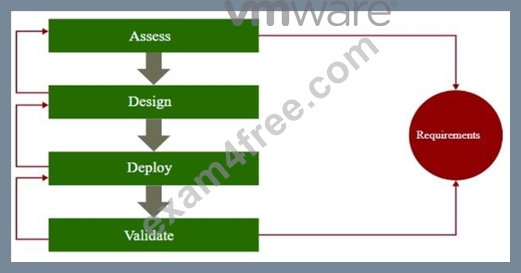
An architect is assigned a new project to design a VMware hybrid cloud solution.
The project is following a proven design methodology following the V-Model of systems engineering and verification. The selected methodology follows these phases: Assess, Design, Deploy and Validate.
Which activity would be conducted during the Design phase?
- A. The architect defines the scope of the project
- B. The architect resolves configuration issues and addresses concerns
- C. The architect conducts a series of group interviews with stakeholders
- D. The architect helps stakeholders learn the mechanics of the solution
Answer: C
Explanation:
Design phase: The purpose of the Design phase is to define how the solution will meet the specific requirements. During this phase, the architect works closely with stakeholders to understand their needs and translate those needs into a technical design. A key activity in this phase often involves refining the solution details through interviews and discussions with key stakeholders to ensure that the design aligns with the business and technical requirements.
NEW QUESTION # 73
An architect is designing a VMware solution for a customer based on the following information:
- The solution must use investments in existing storage array that supports both block and file storage.
- The solution must support the ability to migrate workloads between hosts within a cluster.
- The solution must support resource management priorities.
- The solution must support the ability to connect virtual machines directly to LUNs.
- The solution should use existing IPv4 based network infrastructure.
- There is no budget for additional physical hardware.
Which two design decisions could the architect make to meet these requirements- (Choose two.)
- A. The ESXi hosts will leverage Fibre Channel (FC)
- B. The ESXi hosts will leverage iSCSI
- C. The ESXi hosts will leverage NFS 3
- D. The ESXi hosts will leverage Fibre Channel over Ethernet (FCoE)
- E. The ESXi hosts will leverage NFS 4.1
Answer: B,C
Explanation:
FC is not IP
NFS4.1 does not support I/O control
https://docs.vmware.com/en/VMware-vSphere/7.0/com.vmware.vsphere.storage.doc/GUID-
8A929FE4-1207-4CC5-A086-7016D73C328F.html
Starting from vSphere 7.0, VMware no longer supports software FCoE in production environments.
https://docs.vmware.com/en/VMware-vSphere/7.0/com.vmware.vsphere.storage.doc/GUID-
6B49866F-7005-4099-84AC-4FB2A1A91F64.html
NEW QUESTION # 74
......
VMware 3V0-21.23 Exam Syllabus Topics:
| Topic | Details |
|---|---|
| Topic 1 |
|
| Topic 2 |
|
| Topic 3 |
|
Ultimate Guide to Prepare 3V0-21.23 Certification Exam for VCAP-DCV Design: https://www.exam4free.com/3V0-21.23-valid-dumps.html
Use Real 3V0-21.23 Dumps - VMware Correct Answers: https://drive.google.com/open?id=1GN_tdLHlidy6LV-ugfehvp7NGr_Qp_IV
