
62 Q&As in UPDATED 1Z0-106 Exam Questions Certification Test Engine to PDF
Get The Important Preparation Guide With 1Z0-106 Dumps
Successful completion of the Oracle 1Z0-106 exam will not only validate an individual's advanced system administration skills but also demonstrate their ability to manage complex Linux environments using the latest technologies and techniques. It is a valuable certification for IT professionals seeking to advance their careers in Linux system administration and management.
Oracle 1Z0-106 Exam is a certification exam designed for professionals who want to showcase their knowledge and skills in Oracle Linux 8 Advanced System Administration. 1Z0-106 exam is specifically designed for professionals who have a solid understanding of Linux system administration and want to master the advanced concepts and features of Oracle Linux 8. 1Z0-106 exam covers a wide range of topics, including system configuration, networking, storage management, and security.
NEW QUESTION # 25
Which two statements are true about the at and batch commands?
- A. at executes a one-time task to run at a specific time.
- B. batch schedules the execution of recurring tasks.
- C. batch executes a task when the system load average is greater than 0.8.
- D. at schedules the execution of recurring tasks.
- E. Both at and batch read from standard input, or you can specify a file and execute the commands with the -f option.
Answer: A,E
Explanation:
Explanation of Answer C:Bothatandbatchcan accept commands from standard input or from a file specified using the-foption. This allows scheduling of tasks by providing the commands directly or reading them from a file.
Explanation of Answer E:Theatcommand schedules a one-time task to run at a specified time. It is used to execute commands once at a particular time in the future.
NEW QUESTION # 26
Examine this command, which executes successfully:
# nmcli con add con-name eth2 type ethernet ifname eth2 \ Ipv6.address 2804:14c:110:ab2f:c3lb:1212:7917:708a/64 \ Ipv6.gateway 2804:14c:110:ab2f::1003 \ Ipv4.address 192.168.0.5/24 ipv4.gateway 192.168.0.254 The eth2 connection does not exist. Which two statements are true?
- A. The configuration is saved in /etc/sysconfig/network.
- B. Ethernet connection eth2 is created.
- C. It configures an automatic IPV6 address.
- D. A static IP address is assigned to the eth2 connection
Answer: B,D
NEW QUESTION # 27
Which two commands relabel an SELinux system after a reboot?
- A. echo "relabel=1" > /.selinux
- B. Set kernel parameter selinux=0
- C. Set kernel parameter autorelabel=0
- D. fixfiles -F onboot
- E. fixfiles -F relabel
- F. touch /.autorelabel
Answer: D,F
NEW QUESTION # 28
Which three statements are true about the journalctl command?
- A. journalctl -p err shows only error log level.
- B. journalctl -p notice..warning shows all messages from notice to warning log level since the last boot.
- C. journalctl -p 6 shows all info log level messages and above.
- D. journalctl -k shows kernel logs since the last boot.
- E. journalctl -bl -p err fails if journal persistence is not configured.
Answer: A,C,D
Explanation:
Option B: journalctl -p err shows only error log level.
* Explanation:
* The -p or --priority option in journalctl filters messages by their priority level.
* When specifying asingle priority level, journalctl shows messagesonlyat that level.
* The priority levels, as per syslog standards, are:
* 0: emerg
* 1: alert
* 2: crit
* 3: err
* 4: warning
* 5: notice
* 6: info
* 7: debug
* Therefore, journalctl -p err displays messages with priorityerr (3)only.
* Oracle Linux Reference:
* OracleLinux 8: Managing Log Files- Section onFiltering Output withjournalctl:
"Use the -p option to display messages from the journal that have a specific priority level."
* Example:
# journalctl -p err
Option D: journalctl -k shows kernel logs since the last boot.
* Explanation:
* The -k or --dmesg option filters messages from the kernel, equivalent to the output of the dmesg command.
* This option implies -b, which limits the output to messages from the current boot.
* Therefore, journalctl -k displays kernel messages since the last boot.
* Oracle Linux Reference:
* OracleLinux 8: Managing Log Files- Section onViewing Kernel Messages:
"Use the journalctl -k command to display kernel messages since the last system boot."
* Example:
# journalctl -k
Option E: journalctl -p 6 shows all info log level messages and above.
* Explanation:
* When specifying a single numeric priority, journalctl displays messages withthat priority level and higher priority levels(i.e., lower severity).
* Priority levels are ordered from 0 (highest severity) to 7 (lowest severity).
* Therefore, journalctl -p 6 shows messages with priorities:
* 0 (emerg)
* 1 (alert)
* 2 (crit)
* 3 (err)
* 4 (warning)
* 5 (notice)
* 6 (info)
* This includesinfo level messages (6)and all higher priority messages.
* Oracle Linux Reference:
* OracleLinux 8: Managing Log Files- Section onFiltering Output with journalctl:
"When you specify a single priority level, journalctl shows messages at that level and higher severity."
* Example:
# journalctl -p 6
Why Other Options Are Not Correct:
* Option A:journalctl -bl -p err fails if journal persistence is not configured.
* Explanation:
* The -b option displays messages from the current boot. This works even if journal persistence isnotconfigured because the logs from the current boot are stored in volatile memory (/run/log/journal).
* Therefore, the command doesnot failif journal persistence is not configured.
* Oracle Linux Reference:
* OracleLinux 8: Managing Log Files- Section onJournal Volatility:
"By default, the journal stores logs in volatile memory and does not persist logs across reboots unless persistent storage is configured."
* Option C:journalctl -p notice..warning shows all messages from notice to warning log level since the last boot.
* Explanation:
* The -p option allows specifying arangeof priorities. However, the correct order for the range should be from thehigher priority (lower number)to thelower priority (higher number).
* Also, the priorities should be specified in the correct sequence, and ranges are inclusive.
* Moreover, journalctl by default shows messages from all boots unless limited by the -b option.
* Therefore, without -b, it does not limit messages to "since the last boot," making the statement incorrect.
* Correct Command:
* To display messages fromwarning (4)tonotice (5), the command should be:
# journalctl -p warning..notice -b
* But even then, the priorities need to be specified correctly, and the command in Option C is incorrect.
Conclusion:
OptionsB,D, andEare correct because they accurately describe the behavior of the journalctl command in filtering and displaying log messages based on priority levels and sources.
NEW QUESTION # 29
Examine these commands, which execute successfully:
# firewall-cmd --zone=public --add-service=cockpit --permanent
# firewall-cmd --zone=public --add-port=1313/tcp --permanent
# firewall-cmd --reload
Which are true upon execution?
- A. Runtime firewall configuration is not lost when the firewalld process is restarted or the system is rebooted.
- B. The Cockpit service is added only to the public zone.
- C. Egress traffic is allowed for the Cockpit service only when using port 1313.
- D. Port 1313 blocks all traffic for the public zone except for ingress traffic to the Cockpit service.
- E. The custom Cockpit service configuration file is updated in /usr/lib/firewalld/services.
Answer: A,B
Explanation:
Explanation of Answer A:The commandfirewall-cmd --zone=public --add-service=cockpit --permanentadds the Cockpit service to the public zone permanently. This means that the service is explicitly allowed only within the public zone, not in any other zones.
Explanation of Answer C:Using the--permanentflag withfirewall-cmdcommands ensures that the changes are stored in the firewalld configuration and are persistent across reboots. Therefore, when thefirewalldservice restarts or the system reboots, the runtime configuration will not be lost, and the changes will remain in effect.
NEW QUESTION # 30
Examine this command:
# nft add rule inet filter input tcp dport 80 drop
Which two statements are true upon execution?
- A. All traffic inbound on port 80 is dropped.
- B. The rule updates the configuration on disk.
- C. The rule is applied to both IPv4 and IPv6 packets.
- D. The rule applies to the input table.
- E. TCP packets inbound on port 80 are dropped.
- F. TCP packets outbound on port 80 are dropped.
Answer: C,E
NEW QUESTION # 31
Examine this output:
Last metadata expiration check: 4:30:21 ago on Mon 26 Oct 2020 03:09:52 PM GMT Installed Packages Name : gzip Release : 9.el8 Architecture : x86_64 Size : 412 k Source : gzip-1.9-9.el8.src.rpm Repository : @System From repo : anaconda Summary : The GNU data compression program URL : http://www.gzip.org/ License : GPLv3+ and GFDL Description : The gzip package contains the popular GNU gzip data compression program. Gzipped files have a .gz extension.
Gzip should be installed on your system, because it is a very
commonly used data compression program.
Which command generated it?
- A. dnf provides /usr/bin/gzip
- B. dnf info /usr/bin/gzip
- C. dnf list /usr/bin/gzip
- D. dnf search /usr/bin/gzip
Answer: B
NEW QUESTION # 32
Examine these Kubernetes components: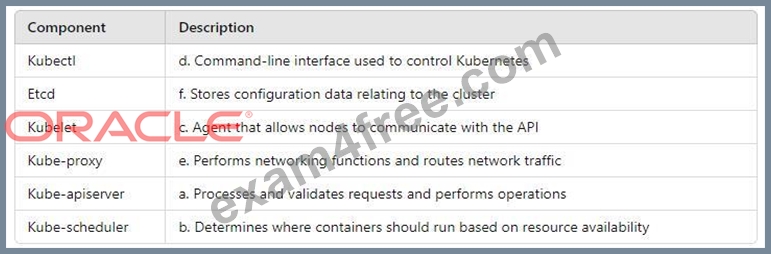
Which option correctly matches the components with their description?
- A. 1-b, 2-a, 3-e, 4-c, 5-f, 6-d
- B. 1-d, 2-f, 3-c, 4-e, 5-a, 6-b
- C. 1-c, 2-f, 3-d, 4-b, 5-e, 6-a
- D. 1-a, 2-d, 3-b, 4-c, 5-e, 6-f
- E. 1-d, 2-f, 3-e, 4-a, 5-c, 6-b
Answer: B
Explanation:
Explanation of Answer E:This option correctly matches the Kubernetes components with their descriptions:
* Kubectl- d. Command-line interface used to control Kubernetes
* Etcd- f. Stores configuration data relating to the cluster
* Kubelet- c. Agent that allows nodes to communicate with the API
* Kube-proxy- e. Performs networking functions and routes network traffic
* Kube-apiserver- a. Processes and validates requests and performs operations
* Kube-scheduler- b. Determines where containers should run based on resource availability
NEW QUESTION # 33
Examine these commands executed by root:
# mkdir -p /jail /jail/bin /jail/lib64
# cp $(which bash) /jail/bin/
# ldd $(which bash)
linux-vdso.so.1 (0x00007ffd574f5000)
libtinfo.so.6 => /lib64/libtinfo.so.6 (0x00007fb458c2c000)
libdl.so.2 => /lib64/libdl.so.2 (0x00007fb458a28000)
libc.so.6 => /lib64/libc.so.6 (0x00007fb458666000)
/lib64/ld-linux-x86-64.so.2 (0x00007fb459177000)
# cp /lib64/libtinfo.so.6 /jail/lib64/
# cp /lib64/libdl.so.2 /jail/lib64/
# cp /lib64/libc.so.6 /jail/lib64/
# cp /lib64/ld-linux-x86-64.so.2 /jail/lib64/
# chroot /jail
What is the output from the cd, pwd, and ls commands?
- A. bash-4.4# cd
bash: cd: /root: No such file or directory
bash-4.4# pwd
/
bash-4.4# ls
bin lib64 - B. bash-4.4# cd
bash: cd: command not found
bash-4.4# pwd
bash: pwd: command not found
bash-4.4# ls
bash: ls: command not found - C. bash-4.4# cd
bash: cd: /root: No such file or directory
bash-4.4# pwd
/root
bash-4.4# ls
bash: ls: command not found - D. bash-4.4# cd
bash: cd: /root: Unable to access chrooted file or directory /root
bash-4.4# pwd
/
bash-4.4# ls
bin lib64
Answer: A
Explanation:
Explanation of Answer A:When thechrootcommand is executed with/jail, the environment is changed to use
/jailas its new root directory. Inside this environment, only the directories and files copied into/jailare accessible. Since/jaildoes not contain a/rootdirectory, the commandcd(which defaults to changing to the user's home directory) will fail, displayingNo such file or directory. Thepwdcommand shows the root of the chroot environment (/), andlsdisplays the contents of/jail, which includesbinandlib64.
NEW QUESTION # 34
Examine these requirements for a host with a user oracle:
* Network services must run in a confined domain.
* The oracle user must be confined.
* The oracle user must be able to use Mozilla Firefox.
* Access to files and directories must be granted based only on SELinux contexts.
* The SELinux configuration must be persistent across system restarts.
* Users must be able to publish private HTML content.
Now examine these commands and output:
# sestatus
SELinux status: enabled
SELinuxfs mount: /sys/fs/selinux
SELinux root directory: /etc/selinux
Loaded policy name: targeted
Current mode: permissive
Mode from config file: permissive
Policy MLS status: enabled
Policy deny_unknown status: allowed
Memory protection checking: actual (secure)
Max Kernel policy version: 31
# setenforce enforcing
# semanage login -a -s guest_u oracle
# setsebool -P http_enable_homedirs on
Which requirements are satisfied?
- A. 1, 2, 3, 5, 6
- B. 1, 2, 4, 5, 6
- C. 1, 2, 4, 6
- D. 1, 2, 3, 4, 5, 6
- E. 1, 2, 3, 6
- F. 1, 2, 6
Answer: B
Explanation:
Explanation of Answer A:
* Network services running in a confined domain: SELinux provides domain confinement for services, ensuring they run with restricted access based on their defined policies.
* The oracle user must be confined: The commandsemanage login -a -s guest_u oracleconfines theoracleuser to theguest_uSELinux user role, which is a confined role.
* Access to files and directories based only on SELinux contexts: With SELinux enabled and the policy loaded, access is governed by SELinux contexts.
* Persistent SELinux configuration across reboots: Thesetenforce enforcingcommand, combined with the appropriate policy configuration, ensures that SELinux remains in enforcing mode across reboots.
* Users able to publish private HTML content: Thesetsebool -P http_enable_homedirs oncommand enables the use of user home directories for web content, allowing users to host personal web pages.
NEW QUESTION # 35
Which two statements are true about control groups (cgroups) in Oracle Linux 8?
- A. A cgroup is a collection of processes bound to a set of limits or parameters defined in the cgroups filesystem.
- B. Cgroups allow processes to be organized into hierarchical groups whose resource usage cannot be limited and monitored.
- C. Different controllers from cgroups version 1 and cgroups version 2 cannot be used at the same time.
- D. The cgroups filesystem allows limits to be overwritten in the lower levels of the hierarchy.
- E. Oracle Linux 8 implements cgroups v2 by default.
Answer: A,E
Explanation:
Explanation of Answer A:Oracle Linux 8 uses cgroups version 2 (cgroups v2) by default. cgroups v2 is a unified hierarchy system that introduces improvements over version 1, including a simplified interface and better resource management capabilities.
Explanation of Answer B:A control group (cgroup) is a mechanism for grouping processes and setting limits or parameters on their resource usage, such as CPU, memory, or I/O. These limits and parameters are configured and managed through the cgroups filesystem.
NEW QUESTION # 36
As root you configured a file system using AutoFS with default settings. In the first session, you changed to a directory under AutoFS control. In a second session, you changed to /etc. Now the idle time for the session expires. Which two statements are true about the status of the file system mounted in the first session?
- A. It remains mounted until you log out from the first session.
- B. It was unmounted from the first session when the timer expired.
- C. It remains mounted as long as the system is running.
- D. It was unmounted when the second session began.
- E. It remains mounted until you switch to a directory outside the current mount point.
Answer: A,E
Explanation:
Understanding AutoFS Behavior:
* AutoFSautomatically mounts file systems when accessed and unmounts them after a period of inactivity (default is 5 minutes).
* A file system remains mounted as long as it isactive, meaning processes are accessing files or directories within it.
Scenario Analysis:
* First Session:
* Changed to a directory under AutoFS control (mount point is active).
* Second Session:
* Changed to /etc (does not affect the first session).
* Idle Time Expires:
* AutoFS checks for idle mounts to unmount.
Implications:
* The mount point remainsactivebecause the shell in the first session is in the AutoFS directory.
* AutoFS willnotunmount the file system while it is active.
Oracle Linux Reference:
* OracleLinux 8: Configuring File Systems-Using the Automounter:
"A file system remains mounted as long as there are open files or directories within it." Correct Options:
* Option B:The file system remains mounted until you log out from the first session.
* Option E:The file system remains mounted until you switch to a directory outside the current mount point.
Why Other Options Are Incorrect:
* Option A:Incorrect because the mount does not persist indefinitely; it's unmounted when no longer active.
* Option C:Incorrect because the mount is still active; the timer does not cause unmounting in this case.
* Option D:Incorrect because the second session does not influence the mount status in the first session.
NEW QUESTION # 37
Which three are features of the btrfs file system?
- A. Cluster file system
- B. Online resizing
- C. Block devices mirroring
- D. Efficient storage for small files
- E. Copy-on-write metadata
- F. General-purpose volume manager
- G. Automatic defragmentation
Answer: B,C,E
NEW QUESTION # 38
Which two statements are true about the configuration and use of cron or anacron?
- A. All crontabs are held in the /etc/cron.d directory.
- B. cron jobs may run only once a minute.
- C. The crond daemon looks for jobs only in /etc/crontab.
- D. anacron jobs are used to run cron jobs if the system was powered off when they were scheduled to run.
- E. anacron jobs may run only once a day.
Answer: D,E
NEW QUESTION # 39
Examine this command:
# auditctl -w /etc/passwd -p w -k pass
Which two statements are true upon execution?
- A. An audit is defined that creates a log entry every time a write occurs to /etc/passwd.
- B. An audit rule is defined with the keyword pass.
- C. A write occurs to /etc/audit/audit.rules.
- D. An audit rule is defined that creates a log entry every time /etc/passwd is read.
- E. A write occurs to /etc/audit/rules.d/audit.rules.
Answer: A,B
NEW QUESTION # 40
Which two directories store PAM authentication modules?
- A. /usr/lib
- B. /lib/security
- C. /var/lib
- D. /lib64/security
- E. /etc/pam.d
Answer: B,D
NEW QUESTION # 41
Which command produces human-readable timestamps in kernel ring buffer messages?
- A. dmesg -W
- B. dmesg -x
- C. dmesg -t
- D. dmesg -T
Answer: D
Explanation:
* Option C (Correct):Thedmesg -Tcommand converts the timestamps in the kernel ring buffer messages to a human-readable format. The defaultdmesgoutput shows the timestamps in a raw format (seconds since the kernel started), while the-Toption translates these timestamps into a human-readable date and time.
* Option A (Incorrect):The-toption is used to remove the timestamps entirely from the output.
* Option B (Incorrect):The-xoption provides extended information about the message (e.g., facility, level).
* Option D (Incorrect):The-Woption waits for new messages and does not convert timestamps to a human-readable format.
Oracle Linux Reference:Refer to:
* man dmesgfor more details ondmesgoptions.
NEW QUESTION # 42
Which two statements are true about kernel boot parameters?
- A. Boot parameters defined as values for the GRUB_BOOT command-line interface are persistent and apply to all subsequent reboots.
- B. Boot parameters are defined as values for the GRUB_CMDLINE_LINUX directive in the /etc/default/grub file.
- C. Parameters passed to the kernel from the GRUB 2 menu are persistent and apply to all subsequent reboots.
- D. Each kernel version's boot parameters are stored in independent configuration files in /boot/loader/entries.
Answer: B,D
NEW QUESTION # 43
Which is true about the /etc/sysconfig directory in an Oracle Linux 8 system?
- A. It is used to access device and device driver information.
- B. Files in this directory hierarchy contain information about system hardware.
- C. Its contents depend on the packages installed on the system.
- D. Files in this directory hierarchy contain information about running processes.
Answer: C
NEW QUESTION # 44
......
Oracle 1Z0-106 certification exam is an essential certification for IT professionals who are seeking to validate their advanced system administration skills on the Oracle Linux 8 platform. Oracle Linux 8 Advanced System Administration certification not only helps professionals to stand out in a highly competitive job market but also helps organizations to identify and hire qualified professionals who can manage their Oracle Linux 8 systems effectively.
Prepare With Top Rated High-quality 1Z0-106 Dumps For Success in Exam: https://www.exam4free.com/1Z0-106-valid-dumps.html
Get Totally Free Updates on 1Z0-106 Dumps PDF Questions: https://drive.google.com/open?id=1dksBWfsvbgIJd2M0leyXbLpJLOsc2oxG
